
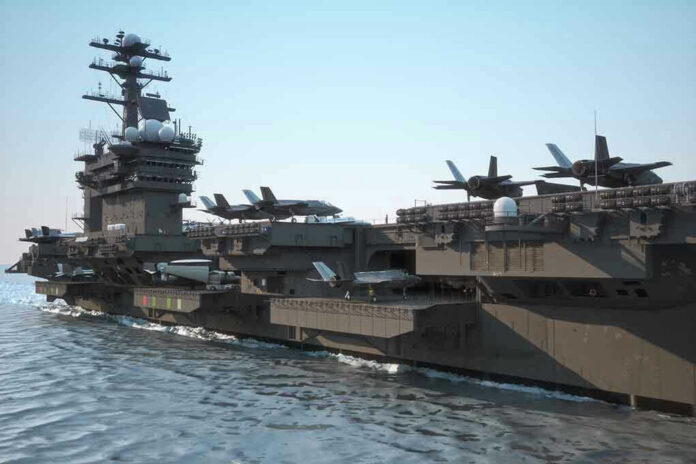
China’s People’s Liberation Army Air Force ramps up J-20 stealth fighter production to 120 per year, projecting a 1,000-plane fleet by 2030 that threatens U.S. air superiority in the Indo-Pacific.
Story Highlights
- PLAAF produces 120 J-20 “Mighty Dragon” fighters annually, outpacing U.S. F-35 and NGAD programs.
- Projections show 1,000 J-20s by 2030, creating numerical dominance over Taiwan and the First Island Chain.
- J-20S two-seat variant enables drone control and anti-carrier strikes, accelerating threats to U.S. naval assets.
- Upgrades like advanced radar and AI integrate J-20 into networked “kill chains” against American carriers.
- U.S. must counter this industrial surge to preserve deterrence under President Trump’s renewed focus on strength.
J-20 Production Surge Alarms U.S. Defenders
Chengdu Aircraft Corporation manufactures J-20 stealth fighters at 120 units annually for the PLAAF. This rate projects a fleet of 1,000 by 2030, dwarfing U.S. fifth-generation output. President Trump’s administration inherits this imbalance from years of delayed programs like NGAD and F/A-XX. The PLAAF prioritizes quantity to overwhelm American qualitative edges in potential Taiwan conflicts. Conservatives demand urgent industrial revival to match China’s output and safeguard national security.
1,000 Stealth Mighty Dragons: The Chilling Math of China’s J-20 Fighter 2030 Stealth Fleet Is a Problem for the U.S. Air Forcehttps://t.co/DNnYY19JzL
— 19FortyFive (@19_forty_five) February 26, 2026
J-20S Variant Targets U.S. Carriers
China unveiled J-20S maritime strike capabilities on January 11, 2026, marking the fighter’s 15th anniversary. The two-seat configuration enables manned-unmanned teaming with drones like GJ-11 for anti-carrier operations. It networks with J-16D electronic warfare jets and KJ-500 radar planes in kill chains aimed at vessels like USS Gerald R. Ford. Analyst Brandon J. Weichert warns this positions J-20S as a deadly threat ahead of U.S. counterparts. Such advancements erode deterrence vital to Trump’s peace-through-strength doctrine.
Key Upgrades Enhance Lethality
Recent enhancements include silicon carbide radar tripling detection to claimed 435 miles, AI integration, improved engines, and longer-range missiles. Analyst Zhang Xuefeng on CCTV touted these for “system-level air warfare” over Taiwan. Production ramp-up since 2025 supports PLAAF modernization. J-20 entered service in 2017 after 2011 prototypes, evolving from air superiority to networked strikes. These developments challenge U.S. F-22 and F-35 advantages, pressing Congress for funding without past wasteful delays.
Western skeptics question stealth radar cross-section and exaggerated ranges due to physics limits. Still, numerical growth remains the core threat. China leads in MUM-T deployment, inverting American tech leads faster than expected.
Strategic Implications for Indo-Pacific
Short-term, J-20 bolsters PLAAF deterrence in the Taiwan Strait, compressing U.S. response times via drone-coordinated strikes. Long-term, 1,000 fighters shift regional balance, forcing accelerated NGAD production or risking inferiority. U.S. carriers and F-35 fleets face heightened vulnerability; Taiwan’s F-16s encounter generational gaps. Allies like Japan and Philippines feel indirect pressure. Trump’s policies counter globalist weaknesses, emphasizing industrial might to protect sovereignty.
China’s military economy surges from this output, spurring U.S. defense debates. Global MUM-T adoption accelerates, pressuring Western firms on semiconductors and rates. PLAAF dominance stems from state funding, while U.S. efforts lag due to congressional hurdles. President Trump must rally for parity to uphold constitutional duties against foreign aggression.
Sources:
China’s New J-20S Stealth Fighter Is a 5th Generation Threat to U.S. Navy Aircraft Carriers
China’s Two-Seat J-20S Will Control Drones and Hunt Aircraft Carriers
China set to supercharge fifth-gen J-20 stealth fighter with radar, engine and AI upgrades
China’s J-20 upgrades to anchor networked air war over Taiwan
China Reveals New J-20 Fifth-Gen Fighter Variant Can Strike Maritime Targets