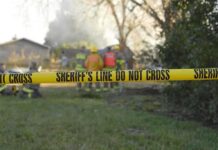
Police say a Sunday family dinner in Billings turned into a massacre that left eight relatives, including four children, dead before the house went up in flames.
Story Highlights
- Officials say the violence began as a family disturbance at a Billings home and escalated to gunfire and fire.
- A family spokesperson told the Associated Press that eight relatives, including four children, were killed.
- Authorities reported no ongoing threat to the public as the investigation continues.
- Research shows many mass shootings are domestic or family violence events.
What Authorities Reported About the Attack
Yellowstone County officials said the scene on White Star Circle involved both a shooting and a fire. Responders arrived Sunday evening and faced gunfire at the property, which later burned, according to the sheriff’s briefing reported by local media. The sheriff’s office and Billings police described the incident as starting with a family disturbance. Investigators secured the area, asked the public to avoid the block, and said there was no ongoing threat to neighbors while they processed evidence and worked to identify victims.
The father of two of the children and a family spokesperson told the Associated Press that a male relative killed eight family members as they gathered for Sunday dinner at the home. The account said four of the victims were children. Local outlets reported that dispatchers heard gunfire during the first 9-1-1 call, which aligns with the rapid timeline officers described at the scene. Authorities have not released a final list of victims or an official motive as the investigation continues.
How the Scene Unfolded on White Star Circle
Local coverage placed the incident at a single-family home in Billings’ West End area. Law enforcement, firefighters, and medical teams converged on the address after reports of shots fired and a structure fire. Interim Sheriff Kent O’Donnell said responders had to take on both the threat of an active shooter and the danger from the flames while trying to reach people inside. Officials later allowed residents to return on a house-by-house basis but kept parts of the block restricted to protect the scene.
Investigators now face a complex forensic task. They need to map bullet trajectories, confirm the sequence of shots, and establish the fire’s origin and cause. Those steps help determine whether the blaze was set to cover evidence or began amid the gunfire. Officials have not publicly detailed the firearm used, how many casings they recovered, or where the fire started. That information often takes days to verify through lab work, interviews, and scene analysis.
Why This Fits a Wider Domestic Violence Pattern
National research shows that many high-fatality shootings happen in private homes and involve family members. A peer-reviewed study found that 59.1 percent of mass shootings from 2014 to 2019 were linked to domestic violence, and 68.2 percent either killed a partner or family member or involved a known history of such violence. Medical and legal researchers have also documented strong ties between firearms, intimate partner abuse, and the risk that more people in the home or nearby will be harmed.
Heartbroken dad in Montana family massacre speaks out after 8 killed in shooting https://t.co/Yte01WVsMX pic.twitter.com/qUGWYB1EbW
— New York Post (@nypost) August 25, 2026
That context matters for policy and prevention. People across the political spectrum see government promises after each tragedy but little steady action that helps families flag danger early and get real support. Many readers also worry that warning signs go ignored until it is too late. Domestic cases are often private and hard to see. Still, patterns are known. Families report sudden rage, threats, or a move back into a home after conflict. Local systems need faster paths to intervene when those red flags stack up.
Community Safety and the Path Ahead
Billings officials said there is no broader threat linked to this case and have focused on a single-family setting. That brings short-term relief for neighbors but leaves a deeper fear that the next blow-up in any home could turn deadly. People want clear, basic steps that work: safe storage of guns, swift follow-up after violent threats, and better support when a relative shows signs of crisis. Those steps do not end freedom; they save lives, especially children’s.
As investigators finish interviews, process shell casings, and analyze fire debris, they will release names and a timeline that answers key questions. For now, what is clear is stark: a dispute inside one Montana home destroyed three generations in minutes. The families who lost loved ones need space and help. The rest of us need systems that act on known risk before a dinner table becomes a crime scene. That is a goal both the left and the right can share.
Sources:
nypost.com, montanarightnow.com, univision.com, instagram.com, wbal.com
© nationalusnews.com 2026. All rights reserved.