
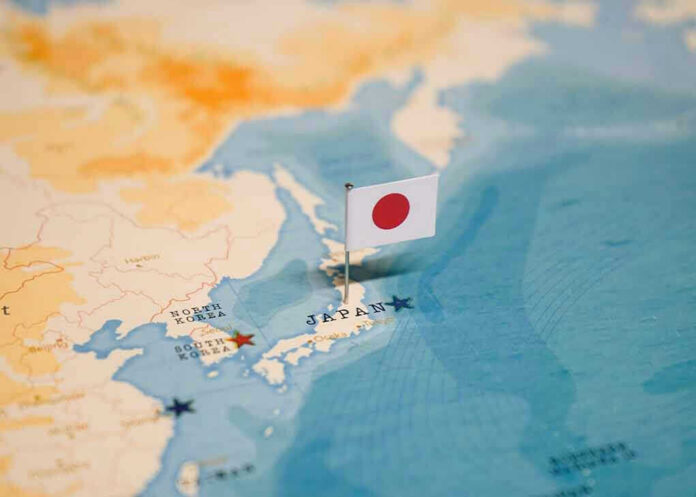
Japan just crossed a red line that could drag America into another Asian conflict—deploying offensive missiles capable of striking deep into China while your sons and daughters are potentially on the hook for defending this provocative move.
Story Snapshot
- Japan secretly deployed upgraded Type-12 missiles with 1,000 km range at Camp Kengun by March 31, 2026, marking shift from defensive to offensive capability
- New missiles can strike China’s eastern seaboard and all of North Korea from Japanese soil, dramatically altering regional military balance
- China condemns deployment as abandoning “defense-oriented” policy, threatens “head-on blow” in response to perceived militarization
- Deployment accelerated by one year amid Taiwan tensions, requiring U.S. intelligence support—potentially entangling America in Asian conflicts
Japan Abandons Seven-Decade Defense Posture
Japan completed deployment of upgraded Type-12 surface-to-ship missiles at Camp Kengun in Kumamoto Prefecture by March 31, 2026, following a secretive overnight transport operation from Camp Fuji in early March. The deployment represents Japan’s first operational long-range counterstrike capability, extending missile reach from 200 kilometers to 1,000 kilometers—a fivefold increase developed by Mitsubishi Heavy Industries. This marks a fundamental departure from Japan’s post-World War II constitution, which limited the nation to “exclusively defense-oriented” policies under Article 9. The accelerated timeline, moved up one year from original plans, signals urgency driven by escalating regional threats.
American Taxpayers Underwriting Asian Arms Race
The Type-12 deployment requires what International Institute for Strategic Studies analysts call U.S. intelligence “connective tissue” for targeting capability, meaning American reconnaissance assets and personnel must support Japan’s offensive operations. From Kumamoto, these missiles cover North Korea and China’s coastal cities; potential future deployments to Japan’s Ryukyu Islands would extend range to all of Taiwan and China’s eastern seaboard. This creates a “missile arc” alongside Philippines’ BrahMos systems and Taiwan’s Hsiung Feng missiles—a containment strategy that places U.S. forces and credibility squarely in the crosshairs of Chinese retaliation. Conservatives who elected Trump to avoid endless wars now face America bankrolling and enabling military buildups that increase conflict probability in the Pacific.
China Threatens Military Response to Provocation
Chinese Defense Ministry spokesperson Jiang Bin condemned Japan’s deployment as abandoning its defensive pretense, warning of a “head-on blow” in response to what Beijing characterizes as resurgent militarism. China’s state-controlled PLA Daily described the deployment as part of a “kill network” targeting Chinese territory, while analysts noted it crosses a “strategic threshold” by complicating China’s naval access through the Miyako Strait—critical for People’s Liberation Army Navy operations and any potential Taiwan scenarios. The deployment also inflames disputes over the Senkaku Islands in the East China Sea. Security experts predict China will expand its own missile deployments and target Japanese bases, fueling a regional arms race that drains resources while increasing miscalculation risks.
Secretive Deployment Sparks Local Japanese Protests
Japanese officials conducted the missile transfer under cover of darkness, sparking protests from Kumamoto residents opposed to the secrecy and military escalation in their community. Chief Cabinet Secretary Minoru Kihara confirmed the March 31 deadline, framing deployment as necessary countermeasures against China and North Korea threats under Japan’s 2022 National Security Strategy. However, the clandestine approach mirrors a troubling pattern where allied governments commit citizens to military postures without transparent debate—a tactic that should concern Americans who value government accountability. Japan’s Ministry of Defense accelerated deployment by one year specifically due to Taiwan tensions, suggesting reactive policymaking rather than measured strategy. This rush to offensive capability raises questions about whether diplomatic solutions received adequate consideration before crossing the Rubicon toward potential first-strike scenarios.
Constitutional Concerns and Slippery Slope
Japan’s pivot from constitutional defense restrictions to offensive counterstrike capabilities occurred through executive policy shifts rather than formal constitutional amendment—a process American conservatives should recognize as government overreach. The 2022 National Security Strategy authorized these capabilities without the rigorous public debate such a monumental change demands, setting precedent for circumventing foundational governing documents when politically convenient. While proponents cite legitimate threats from Chinese naval expansion and North Korean missiles, the solution entangles America deeper into Asian security commitments at a time when the administration promised to reduce overseas military burdens. The deployment also stimulates defense contractor profits—Mitsubishi Heavy Industries benefits directly—while taxpayers fund the intelligence infrastructure enabling these systems, a form of corporate welfare wrapped in national security justifications.
Sources:
Asia Times – Japan deploys upgraded Type-12 missiles, spiking China tensions
Global Times – China Defense Ministry Response
Stars and Stripes – Japan Type-12 missile deployment
IP Defense Forum – Tokyo deploying domestically developed counterstrike capabilities
Economic Times – Japan’s 1000km Type-12 missile may create kill network