With one two-week ceasefire announcement, the price Americans pay for energy swung hard—showing how fragile “energy security” really is when a single chokepoint can rattle the entire world.
Story Snapshot
- Oil prices plunged below $100 a barrel after President Trump announced a conditional, two-week “double-sided” ceasefire with Iran tied to reopening the Strait of Hormuz.
- Global stocks rallied and the U.S. dollar weakened as markets priced in a near-term reduction in war and supply-shock risk.
- Pakistan’s government emerged as the key mediator, with Prime Minister Shehbaz Sharif inviting U.S.-Iran talks in Islamabad aimed at a more permanent deal.
- The ceasefire’s durability remains uncertain because safe passage through the Strait still needs real-world verification through resumed vessel movements.
Oil’s Sudden Drop Reveals How Much Risk Was Priced In
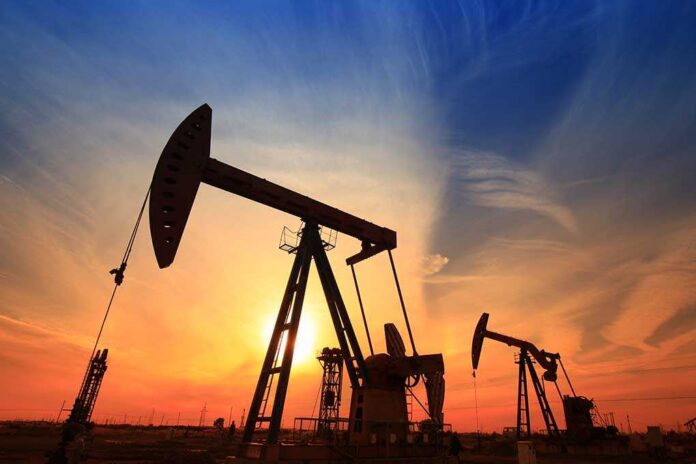
On April 7–8, crude prices posted their sharpest one-day drop since the 1991 Gulf War, with West Texas Intermediate sliding into roughly the mid-$90s and Brent also falling to around $95. The move followed President Trump’s announcement of a conditional two-week ceasefire with Iran. The market’s reaction underscored a simple reality: much of the recent price surge was a geopolitical “risk premium” tied to fears that the Strait of Hormuz would stay closed.
That premium had built rapidly since late February, when fighting pushed prices far above pre-conflict levels near $73 and into record territory for physical crude benchmarks. During March, prices logged an historic monthly rise amid the Hormuz blockade and U.S.-Israeli strikes. When traders saw even a temporary path toward reopening the Strait—through which about one-fifth of global oil flows—panic bids reversed. Even so, prices near $95 remain elevated versus early-2026 levels.
Trump’s Ceasefire Terms: Strait Access in Exchange for a U.S. Pause
The announced arrangement was framed as transactional and conditional: Iran would restore access through the Strait of Hormuz, and the United States would suspend attacks for the same period. Trump also described Iran’s “10-point proposal” as workable and suggested negotiations could produce a definitive agreement. Iranian officials confirmed a halt to attacks and said Iranian forces would coordinate safe passage in the Strait, aligning the truce with the shipping lane’s reopening.
Pakistan’s role stood out because it positioned itself as the intermediary between two adversaries with limited trust and a long history of escalation. Prime Minister Sharif said the ceasefire began immediately and invited both sides to talks in Islamabad. A separate point of contention involved the ceasefire’s scope: Pakistan suggested Lebanon was included, while Israel reportedly disputed that interpretation. That dispute matters because it signals how quickly “side fronts” can challenge any broader pause.
Markets Rallied, but the Strait Must Reopen in Practice—Not Just on Paper
Equity markets in Asia rose sharply as the ceasefire reduced the immediate risk of supply disruption, while the U.S. dollar weakened as investors rotated out of crisis positioning. That relief trade made sense: the Hormuz closure had threatened not only oil supply but also shipping insurance costs and delivery schedules across global trade. Analysts also cautioned that the optimism hinges on observable changes, especially reliable vessel traffic, rather than statements alone.
What This Means for Americans: Energy Costs, Inflation Pressure, and Trust in Institutions
For U.S. households, cheaper crude can translate into easing gasoline and diesel prices, lowering pressure on inflation and shipping costs. For conservatives already frustrated by high energy costs and years of policy-driven constraints on reliable fuel, the episode reinforced the value of energy independence and resilient supply chains. At the same time, skeptics across the political spectrum see a deeper problem: everyday Americans are whipsawed by decisions and conflicts far from home, while institutions struggle to deliver stability.
For now, the ceasefire functions more like a test than a settlement: it can calm markets quickly, but it also sets up a clear pass-fail metric—whether the Strait reopens and stays open under real conditions. If talks in Islamabad produce a longer-term framework, the risk premium could keep draining from prices. If the truce collapses, the world could snap back into volatility just as fast, with consumers absorbing the shock.
Oil traders, shipping firms, and ordinary drivers will be watching the same indicator in the coming days: confirmed, routine transit through Hormuz without attacks. Until that becomes consistent, the story is less about a victory lap and more about a reminder that national prosperity still depends on hard power, credible diplomacy, and practical control of strategic corridors—especially when the federal government’s ability to prevent shocks is increasingly questioned by voters on both sides.
Sources:
https://www.axios.com/2026/04/07/oil-prices-plunge-us-iran-war-ceasefire-trump
https://cambodianess.com/article/crude-prices-plunge-stocks-surge-as-us-and-iran-agree-ceasefire
https://www.channelnewsasia.com/world/us-iran-trump-oil-crude-prices-drop-two-week-ceasefire-6042351