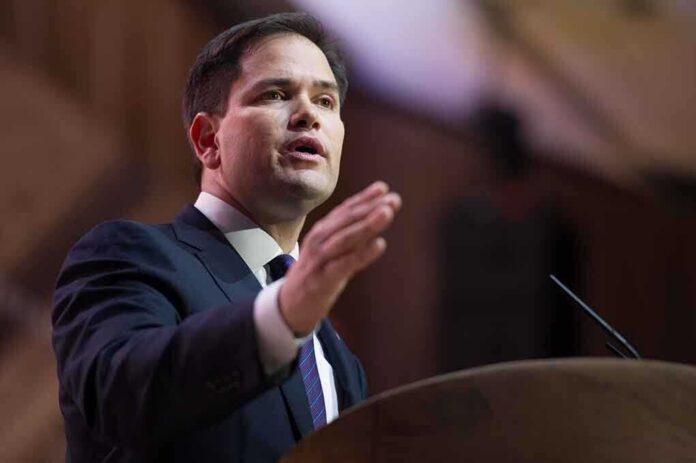
Marco Rubio’s blunt message on the Strait of Hormuz exposes a hard truth many Trump voters are wrestling with: America may not “need” the route—but Washington could still get pulled into policing it for everyone else.
Quick Take
- Secretary of State Marco Rubio says the U.S. gets “very little” energy through the Strait of Hormuz, while allies in Asia and Europe have far more at stake.
- Iran has signaled it wants to change the rules in the Strait, including reported demands for costly transit payments from ship operators.
- The Trump administration is framing Strait security as a global burden-sharing issue, not an American-led mission.
- Higher oil prices and shipping uncertainty are pressuring households and businesses, fueling fresh “endless war” backlash inside the MAGA coalition.
Rubio’s Core Argument: Allies Rely on Hormuz More Than the U.S.
Secretary of State Marco Rubio has drawn a sharp distinction between America’s energy exposure and that of key allies when it comes to the Strait of Hormuz. Rubio publicly emphasized that only a small portion of U.S. energy flows through the chokepoint, while other nations—especially in Asia and parts of Europe—depend heavily on it. The Strait remains central to global markets, with roughly 20% of global energy supplies transiting the waterway.
Rubio’s framing matters politically because it lands in the middle of a growing split among Trump supporters over another Middle East conflict. Many voters who endured years of “globalism” arguments and runaway spending now see foreign security commitments as an open-ended bill that never gets paid off. Rubio’s message attempts to redefine the mission: the U.S. can participate, but allied nations that benefit most should carry more responsibility for keeping international waters open.
Iran’s Pressure Campaign: Threats, “Toll” Claims, and Demands
Iranian officials have signaled an intent to alter the status quo in the Strait, including statements that the “regime” governing Hormuz will not remain as it was. Reporting also describes claims that ship operators have faced steep demands—figures as high as $2 million per transit—tied to war costs, with some vessels allegedly paying quietly. Iranian lawmakers have publicly argued Tehran has the “right” to demand such charges, framing the issue as sovereign power.
U.S.-Iran diplomacy appears active but unresolved. Reporting describes a U.S. 15-point plan touching Iran’s nuclear program, ballistic missiles, and maritime security, followed by an Iranian rejection and a counter-list of conditions. Among the conditions cited are recognition tied to Iran’s claims over the Strait and reparations demands connected to war damage. Rubio has also described indirect communications through intermediaries and said energy flows have increased somewhat, though not to normal levels.
What “Burden-Sharing” Looks Like When Oil Prices Hit Home
The immediate impact of uncertainty in Hormuz is felt through energy and shipping costs. Reporting links disruptions and threats around the Strait to upward pressure on global oil prices, and shipping operators face security risks and operational headaches. For conservative households, that translates into the kind of cost-of-living squeeze that is hard to ignore: higher gasoline and diesel prices, more expensive goods moved by truck, and renewed anger that U.S. policy can’t seem to avoid overseas crises.
Allies’ Reluctance and the Risk of Another Open-Ended Commitment
Rubio’s call for allied nations to “step up” comes as some partners reportedly hesitate to join U.S. requests connected to the Iran conflict, citing concerns about consultation and decision-making. That gap—between who benefits most from Hormuz staying open and who is expected to enforce it—sits at the center of today’s conservative debate. If the mission expands without clear objectives, voters who backed Trump to end “regime change” style wars may see another repeat of the past.
The Constitutional Question Voters Keep Asking: Who Decides, and What’s the Endpoint?
Rubio has described keeping the Strait open as an “immediate challenge” after military operations and suggested the U.S. does not have to lead any plan, while remaining willing to participate. That statement may reassure voters who want limits, but it does not answer the question many are now demanding from Washington: what is the defined endpoint, and what commitments—military, financial, and political—will be made in America’s name? The available reporting does not provide firm timelines.
For Trump’s second-term coalition, Rubio’s “reality check” is both a warning and a test. The warning is that Iran’s attempt to control an international chokepoint would set a dangerous precedent for global shipping norms. The test is whether the administration can protect American interests without sliding into a long conflict that drains resources, inflates energy costs, and deepens public distrust. On the facts available, Rubio is trying to shift the burden—yet the political risk remains that the U.S. still gets stuck holding the line.