nationalusnews.com — Silicon Valley’s most powerful map quietly “un-burned” a California fire zone for weeks, and Google now wants America to accept a one-line excuse and move on.
Story Snapshot
- Google Maps temporarily showed Pacific Palisades neighborhoods as untouched, despite massive wildfire destruction.
- Google admits it “accidentally” rolled back to pre-fire satellite imagery after a routine update.
- Residents say the false imagery lingered long enough to raise questions about transparency and accountability.
- The episode renews conservative concerns about big tech control over what Americans see as “reality.”
Google Maps Quietly Rewrote a Fire-Ravaged Community
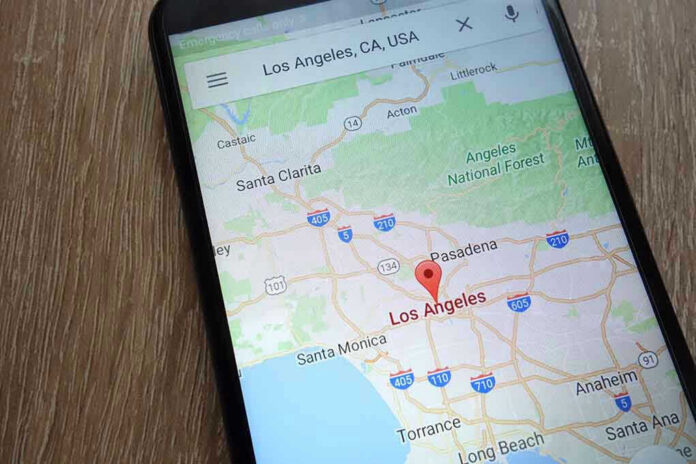
Google Maps users in Los Angeles recently opened their phones and saw something they knew was false: Pacific Palisades neighborhoods that burned in a devastating wildfire were suddenly displayed as if nothing had ever happened. Homes, streets, and landmarks that were destroyed reappeared in crisp, pre-fire condition on satellite view, effectively erasing visible evidence of the disaster from one of the world’s most trusted mapping platforms. TMZ documented the anomaly and called out that Google Maps “appeared to have rolled back” parts of Los Angeles to pre-fire imagery, making burned-down neighborhoods “look untouched again.” [1]
Google did not deny what users saw. A company spokesperson told TMZ the platform had suffered “a technical issue triggered by a recent, routine update to satellite imagery in Google Maps and Earth, which accidentally restored old imagery from before the fire.” The same spokesperson said, “We’re fixing it ASAP,” and later claimed the issue had been corrected, with “post-fire imagery rolling out again now.” [1] For a brief but real period, however, the map that millions rely on showed a Los Angeles that no longer exists.
Residents Say the “Glitch” Lasted Long Enough to Matter
For those on the ground, this was not some blink-and-you-miss-it flicker. A thread on Google’s own help forum, titled “Pacific Palisades Wildfire Aftermath – Satellite View,” describes how, from January 2025 through April 2026, satellite view correctly showed which streets and homes had burned. Then “a couple weeks ago,” users say, the imagery suddenly changed back to older, pre-fire pictures. [2][3] That timeline suggests an enduring, accurate record was replaced by outdated imagery that obscured the destruction, and it stayed that way long enough for residents to compare, discuss, and challenge what they were seeing.
People noticing the rollback were not obscure technical testers. TMZ highlighted how regular users, including public figure Spencer Pratt, saw Google’s map apparently restore homes and landmarks that had been wiped out by fire. [1] When ordinary Americans can plainly see that reality on the ground does not match what big tech is publishing from the cloud, trust takes a hit. Even if Google’s explanation is correct and the event was accidental, users had to live with a digital version of their community that quietly rewrote painful recent history.
Big Tech’s Control Over “Reality” Fuels Conservative Skepticism
This incident touches a deeper concern that many conservatives have had for years: platforms like Google decide what reality looks like on our screens. Scholars and watchdogs have long warned that modern digital maps are not neutral; they are curated products shaped by corporate decisions, political pressures, and behind-the-scenes governance. When a company can make a burned neighborhood appear pristine again with one imagery rollback, it underscores how easily powerful platforms can smooth over uncomfortable facts or shape the visual story citizens receive.
Past controversies about Google Maps have shown that labeling choices, border lines, and routing decisions can reflect political priorities as much as technical ones. [4] In that context, the Palisades rollback enters a pattern, not a one-off curiosity. While the available evidence here supports a technical error rather than proven intent to influence public perception, the lack of detailed technical transparency leaves room for justified skepticism. [1][2] Without change logs, version histories, or independent audits, Americans are effectively asked to “just trust” the same institutions that already wield enormous power over search results, speech, and news visibility.
What We Know, What We Do Not, and Why It Matters
The facts on record establish several key points. Google Maps and Google Earth did show pre-fire imagery over an area that had long been correctly mapped as burned, and users across Los Angeles noticed the rollback. [1][2] Google acknowledged the problem and described it as accidental, tied to a routine satellite imagery update. [1] A support thread confirms the rollback was not a fleeting hiccup but a condition that persisted long enough for residents to document the change and ask for answers. [2][3] What we do not have is technical proof of what, exactly, went wrong in the imagery pipeline.
The absence of hard technical documentation does not prove malicious intent, but it also does not earn blind trust. In a climate where conservatives have watched big tech throttle stories, skew search results, and quietly police “acceptable” narratives, even an admitted glitch has political resonance. The prudential response is not to spin conspiracy theories, but to demand verifiable transparency: detailed postmortems, clear version histories, and accountability when platforms alter how Americans see their own communities. A free people should never let unaccountable corporations become the unseen editors of reality.
Sources:
[1] Web – Google Maps Blames Glitch for Pre-Palisades Fire Satellite Images …
[2] Web – Pacific Palisades Wildfire Aftermath – Satellite View – Google Help
[3] Web – Palisades fire victims claim a state park official restricted … – LA …
[4] Web – Forms | Los Angeles City Planning
© nationalusnews.com 2026. All rights reserved.