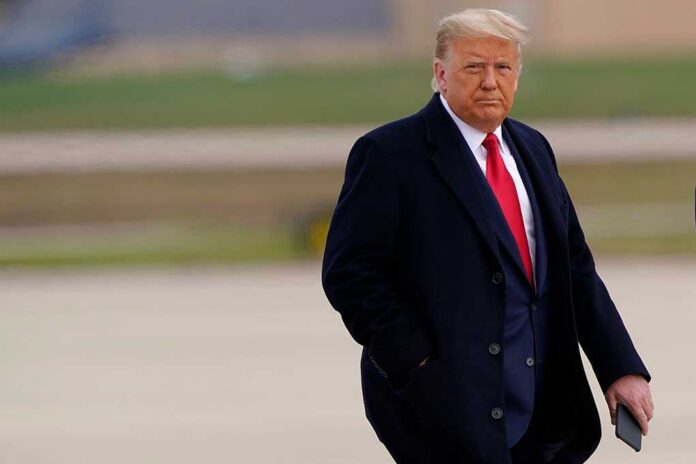
With a ceasefire clock ticking down, President Trump is betting that maximum pressure—not Obama-style concessions—can force Iran to surrender its nuclear leverage.
Quick Take
- Trump said he feels “no pressure whatsoever” to sign an Iran deal and warned he won’t repeat what he calls the Obama-era JCPOA mistakes.
- Talks centered in Pakistan appear stalled, with reports that Iran has skipped attendance even as U.S. negotiators remain engaged.
- Trump has publicly swung from claiming a deal is “close” to threatening major strikes if Iran refuses to comply.
- The U.S. posture includes active leverage in and around the Strait of Hormuz, a critical global energy chokepoint tied to price spikes and shipping risks.
Trump’s “No Pressure” Message Signals a Familiar Negotiating Theory
President Donald Trump used Truth Social and public remarks on April 20 to argue he is “under no pressure whatsoever” to make a deal with Iran, framing time as an advantage rather than a constraint. Trump positioned his stance as a rejection of the 2015 nuclear agreement reached under President Barack Obama, which he has long criticized. The White House message is straightforward: any agreement must permanently end Iran’s nuclear path, not merely pause it.
Trump’s rhetoric over the last several days also illustrates how his administration mixes diplomacy with deterrence. On April 17, he said an agreement was close and suggested Iran had agreed to key terms, including uranium-related concessions. By April 19–20, he shifted to warnings of major military action if Iran refuses to finalize a deal. That change has fueled debate about credibility, but it also telegraphs an intent to keep Iran off-balance as deadlines approach.
What Makes This Round Different From the 2015 JCPOA Dispute
The political argument inside the U.S. is not just about whether to negotiate, but about what kind of deal prevents a nuclear Iran without rewarding the regime. Critics of the JCPOA pointed to enforcement challenges and “sunset” provisions that could allow Iran to rebuild capabilities later. Trump’s 2018 withdrawal from the JCPOA remains central to today’s posture, with the administration emphasizing that any new agreement must be meaningfully stronger than Obama-era limits.
Based on the available reporting, the current U.S. demands are described as more absolute than the JCPOA’s structure—focused on eliminating Iran’s nuclear capability rather than managing it. Coverage also highlights proxy activity as part of the broader dispute, with pressure tied to Iran-backed groups such as Hamas and Hezbollah. The practical point for Americans is that nuclear talks are being linked to regional security behavior, not treated as a separate technical file handled in isolation.
Pakistan Talks, A Ceasefire Deadline, and Conflicting Signals From Tehran
The immediate friction point is the peace-talk framework in Pakistan as the ceasefire window nears its end. Reports indicate U.S. negotiators, including Vice President JD Vance, have been involved, while Iran has reportedly refused to attend at points—an inconsistency with claims that “most points” are already agreed. That gap matters because it suggests either unresolved terms or a deliberate Iranian tactic to delay while testing whether U.S. pressure can be waited out.
Trump has also said the U.S. will act if no agreement is reached, and recent reporting describes threats aimed at infrastructure targets if diplomacy collapses. That posture increases the risk of rapid escalation, especially if each side claims the other violated the ceasefire or maritime norms. For voters skeptical of “forever wars,” the key question is whether coercive leverage can produce a verifiable end-state—one that blocks nuclear breakout—without dragging the U.S. into another open-ended conflict.
Why the Strait of Hormuz Is the Economic Pressure Point Americans Feel
The Strait of Hormuz remains a strategic choke point where military pressure and economic consequences collide. Reporting tied to the blockade environment and maritime seizures underscores why energy markets react quickly to disruptions: a credible threat to shipping routes can raise global oil prices and filter into American household costs. In that sense, the Iran standoff is not abstract foreign policy; it can land directly on consumers through inflation-sensitive categories like gas and transportation.
The administration’s supporters argue this pressure is the point—using sanctions, blockade leverage, and deterrence to force compliance rather than offering upfront relief. Critics counter that sharp rhetoric can destabilize negotiations. Both concerns can be true at once: deterrence can create leverage, while inconsistent messaging can complicate diplomacy. With limited confirmed information on whether a final document is ready for signature, the public should treat optimistic timelines cautiously until verifiable steps occur.
Trump Says He Feels 'No Pressure' to Make Deal With Iran, Won't Make the Mistakes Obama Didhttps://t.co/NQYaCPWkyR
— RedState (@RedState) April 20, 2026
If a deal is reached, the long-term test will be verification—whether Iran’s nuclear capability is truly dismantled and whether proxy funding and attacks decrease in measurable ways. If talks fail, Americans should expect heightened regional risk, potential strikes, and more market volatility tied to shipping security. Either outcome reinforces a broader reality many voters across the spectrum already feel: foreign policy decisions made by Washington’s elite can quickly become kitchen-table issues for working families.
Sources:
https://www.axios.com/2026/04/05/trump-iran-deal-power-plants
https://www.cbsnews.com/news/trump-messaging-iran-after-he-said-tehran-agreed-to-everything/
https://en.wikipedia.org/wiki/United_States_withdrawal_from_the_Iran_nuclear_deal