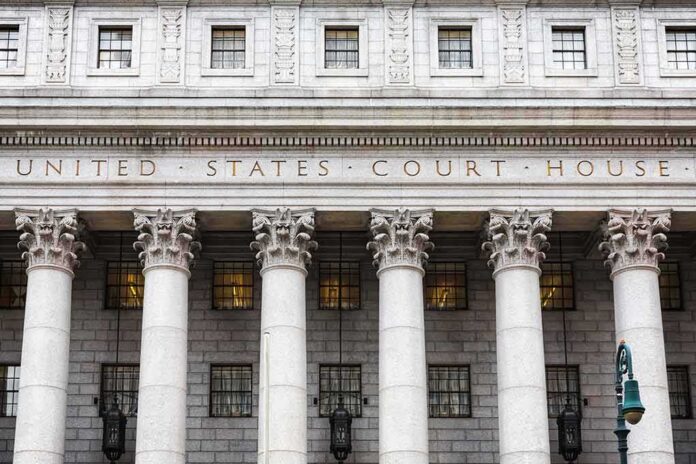
When the Supreme Court said states can keep girls’ sports for biological females, two former stars cheered and aimed their message straight at Olympic legend Simone Biles.
Story Snapshot
- The Supreme Court upheld Idaho and West Virginia laws that bar transgender girls from competing in girls’ school sports, saying these bans do not violate Title IX or the Constitution.
- The ruling confirms that schools may separate teams by biological sex, while leaving other states free to choose different policies.
- Riley Gaines and Olympic gymnast MyKayla Skinner celebrated the decision as a major win for the “Save Women’s Sports” movement and called out Simone Biles over past criticism.
- The decision deepens a national fight over fairness, inclusion, and whether elites in sports and government are listening to everyday women and girls.
Supreme Court backs state bans while limiting the scope
On Tuesday, the United States Supreme Court ruled that states may bar transgender girls and women from competing on girls’ and women’s school sports teams, upholding bans in Idaho and West Virginia. Writing for a 6–3 majority, Justice Brett Kavanaugh said states can determine eligibility for female sports based on biological sex and that this does not violate Title IX or the Constitution’s Equal Protection Clause. The Court stressed that the Constitution does not force schools to overhaul women’s sports nationwide, but allows states that wish to keep teams sex-based to do so.
The ruling came in two cases, Little v. Hecox from Idaho and West Virginia v. B.P.J., both focused on whether state lawmakers can restrict school sports participation based on biological sex. The Court’s decision is expected to apply to similar laws already passed in more than half the country, where many Republican-led states have adopted bans on transgender girls in female sports. At the same time, the opinion makes clear that states which allow transgender participation may keep those policies, so there is no nationwide mandate in either direction.
Gaines and Skinner hail a defining victory for women’s sports
Former NCAA swimmer Riley Gaines, now a leading critic of transgender inclusion in women’s sports, quickly framed the decision as a landmark moment for protecting fairness and safety for female athletes. She has long argued that “Save Women’s Sports” is about equal opportunity for girls, saying public opinion and science favor sex-based categories and that it is “astonishing” women still have to fight for basic equality in athletics. After the ruling, she said she felt “absolutely vindicated” and urged others to see the Court’s language as proof that states are free to keep women’s sports for biological females.
Olympic gymnast MyKayla Skinner joined Gaines in celebrating the decision and tying it to her role as a mother. Skinner said she speaks out because she wants her daughter to have equal athletic opportunities, without losing spots or scholarships to athletes who went through male puberty. In earlier statements, she praised Gaines as “brave” for raising these issues and warned that women who question current policies are often mocked instead of heard. Skinner’s reaction to the ruling fits that pattern, treating the Court’s opinion as long-awaited recognition of those concerns.
Message to Simone Biles and a split among star athletes
Gaines and Skinner also used the moment to send a pointed message to Simone Biles, their sport’s most famous active star. In 2025, Biles publicly criticized Gaines over her comments on transgender athletes and called her a “sore loser,” before later deleting the posts amid backlash. Skinner has said she felt “belittled” and “ostracized” by Biles in the past and accused her of using her platform to bully rather than debate, while insisting no woman should be punished for raising fairness concerns. The Court’s ruling gave Gaines and Skinner a new stage to push Biles to rethink her stance.
Riley Gaines and MyKayla Skinner send message to Simone Biles on women's sports debate after SCOTUS rulinghttps://t.co/3NB5ZvRJ7U
— RED Sand🟥 🇺🇲🇮🇱🇬🇧🇩🇪⚓🤿🏴☠️🔱🃏♦️♣️♥️♠️ (@Trumplar) July 1, 2026
Following the decision, Gaines urged well-known female athletes such as Caitlin Clark, Sophie Cunningham, and Serena Williams to “link arms” and publicly support keeping women’s sports limited to biological females. She argued that big names have the power to sway public opinion but often stay silent out of fear of backlash or pressure from sponsors and sports organizations. That appeal highlights a growing divide inside women’s sports, where some champions back inclusion while others feel speaking up for sex-based categories risks their careers and reputation.
Broader fight over fairness, inclusion, and trust in institutions
This ruling fits into a wider trend of state-level laws and federal actions that focus on transgender participation in schools and sports. Since the late 2010s, the number of states with restrictions on transgender athletes has grown from none to well over twenty, often after debates that pit “biological fairness” against inclusion and civil rights. In 2025, President Trump signed an executive order signaling that the federal government would use Title IX enforcement to exclude transgender girls and women from girls’ and women’s sports and locker rooms in many settings, deepening the policy shift.
Supporters of the bans say the Court has finally sided with common sense and science, arguing that sports are “zero-sum” and every roster spot or medal lost to a transgender girl comes at the expense of a biological female. They see the decision as a win against what they view as elite-driven policies that ignore everyday parents and athletes. Critics, including civil rights lawyers and groups like the American Civil Liberties Union, counter that these laws target a very small group of students, fuel stigma, and are not backed by solid data showing unfairness. Even the majority opinion notes that states “may” discriminate in this way but are not required to, leaving the political and moral debate very much alive.
Unanswered questions and what comes next
While the Court settled the narrow question of whether states can keep girls’ sports for biological females, it left key issues unresolved. The ruling did not decide whether schools or states must allow transgender girls to compete on female teams, or how policies should work in professional leagues and the Olympics. Major sports bodies, such as the National Collegiate Athletic Association and the International Olympic Committee, have not yet laid out clear responses to this decision, creating uncertainty for athletes moving between school and elite competitions.
Advocates on both sides agree more information is needed. There is still no national data set that shows how many transgender athletes compete in girls’ sports or how often they reach podiums or earn scholarships at the expense of other girls. Researchers and legal experts have called for careful studies of physical differences after transition, as well as testimony from coaches and athletes about real-world impacts. Until those gaps are filled, many Americans on both the left and the right will keep wondering whether the people in charge of sports and government are truly solving problems, or just fighting culture wars while ordinary families are left to deal with the fallout.
Sources:
thegatewaypundit.com, foxnews.com, aol.com, youtube.com, republicanags.com, instagram.com, nytimes.com
© nationalusnews.com 2026. All rights reserved.