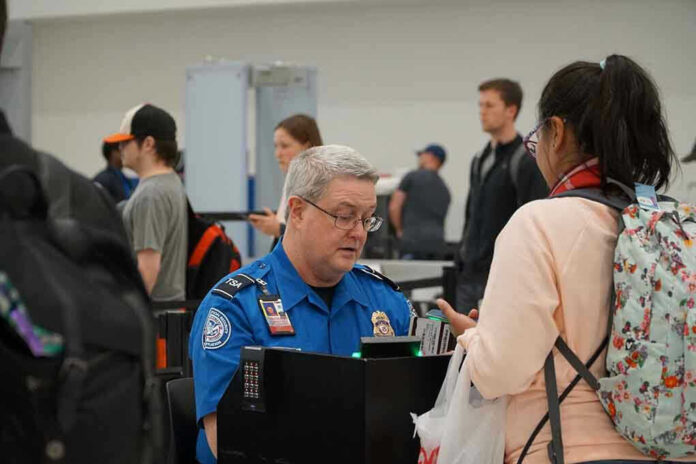
After nearly a quarter-century of Americans hopping around barefoot at airports like a herd of sheep, the TSA has finally scrapped its infamous shoe removal mandate at select security checkpoints—thanks to technology that, believe it or not, has existed for years.
At a Glance
- The TSA no longer requires passengers to remove shoes at security in select airports, citing improved scanning technology.
- This marks the first rollback of a 9/11-era policy that has frustrated millions since 2001.
- Implementation is rolling out in phases, with the policy not yet universal or available to all travelers.
- Officials claim this will cut wait times and improve the passenger experience, but critics question why common sense took so long.
Government Finally Backs Down from the Shoes-Off Ritual
It took 24 years, several bureaucratic empires, and more than a few pairs of holey socks, but the TSA has finally admitted what most Americans have known since the day “take your shoes off” became gospel at our airports: the entire spectacle was overdue for the trash bin. As of July 8, 2025, select U.S. airports have begun allowing travelers to keep their shoes on at security checkpoints, ending a policy that originated in a panic after one idiot tried to light his sneakers on a plane back in 2001. The catalyst for this shift? Not some sudden epiphany about respecting travelers’ dignity, but the arrival of “cutting-edge” scanning machines—technology that, by the way, other countries and even our own PreCheck lines have been using for over a decade.
The change is being rolled out in phases—so don’t toss your airport slip-ons just yet. Airports in Seattle, Baltimore, Los Angeles, and New York’s LaGuardia are among the first to implement the new protocols. But, as usual, the government can’t resist putting a few asterisks on every supposed improvement: if you don’t have a REAL ID, or you’re traveling through an airport that’s behind the curve, you may find yourself back in the sock parade. All of this comes under the guise of “travel modernization,” a phrase that always seems to mean “we’ll fix the stuff we broke years ago, but only after making you jump through a few more hoops.”
The Bureaucratic Dance: Why Did It Take Decades?
The shoes-off mandate was born in the shadow of 9/11, when the government’s favorite solution to every problem was to treat everyone like a suspect. Richard Reid, the so-called “shoe bomber,” tried—and failed—to blow up a plane with explosives in his sneakers. The knee-jerk reaction? Make every single American, from toddlers to grandparents, parade barefoot through airport security for decades. Meanwhile, the TSA PreCheck program has quietly allowed pre-approved travelers to keep their shoes on since 2006, proving all along that the technology to vet and screen safely was available. So why did the policy last this long? Because once the government grabs hold of your shoes, it’s never keen to give them back.
The official line now is that new screening machines can “detect threats without requiring removal of footwear.” In other words, the bureaucrats are finally catching up to what the rest of us have been saying: you don’t need to treat law-abiding Americans like cattle to keep them safe. The Department of Homeland Security and the TSA are spinning this as a victory for modernization and efficiency, giving themselves a pat on the back for finally ending a security theater performance that most of the world stopped watching years ago.
Winners, Losers, and the Politics of Common Sense
Who wins from this long-overdue change? Regular Americans, for once—especially those who’ve long held that the government’s obsession with “doing something” usually means more hassle and less liberty. Airport wait times are set to drop, traveler satisfaction is up, and the travel industry might even see a boost as flying becomes a little less humiliating. The TSA, of course, gets to crow about its “multi-layered security approach,” as if basic common sense counts as an innovation.
But before we start celebrating, let’s not forget: the distinction between regular and PreCheck screening is now blurrier than ever, and the government’s love affair with REAL ID means plenty of travelers will still be stuck in the old routine. And don’t expect other unnecessary policies—like the infamous liquid restrictions—to evaporate overnight. The real question is why it took so long for the government to trust its own technology, and why Americans were forced to endure a quarter-century of pointless ritual in the first place. Maybe, just maybe, this is a sign that even the most stubborn bureaucrat can eventually stumble onto a bit of common sense—though only after years of wasted time, money, and patience from the people they supposedly serve.