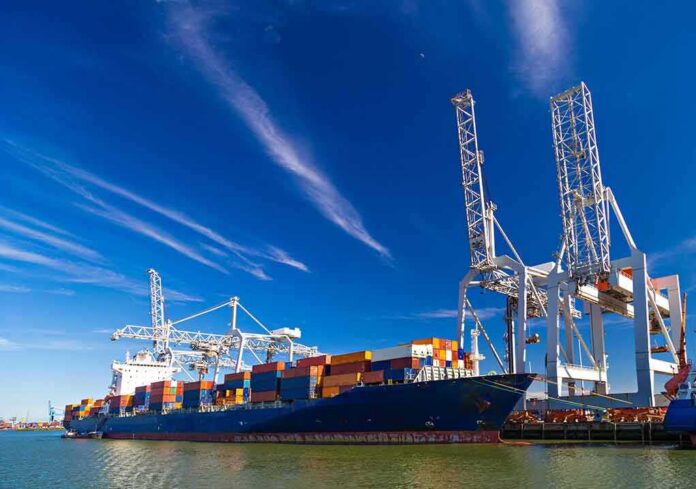
China’s global port building now comes with built-in military options, and the paperwork backs it up.
Story Snapshot
- Chinese laws and strategy documents support dual-use designs for overseas ports.
- Researchers flagged many Belt and Road ports as suited for future naval access.
- Official testimony cites “strategic strongpoints” and one confirmed base in Djibouti.
- Chinese officials and the World Bank still stress economic gains and cooperation.
What China’s Laws and Plans Say About Overseas Ports
Asia Society Policy Institute researchers report that Chinese laws push overseas infrastructure to meet military standards. The rules let the military take control of assets owned by Chinese firms during emergencies or war. That structure helps turn commercial sites into military-ready facilities fast. United States analysts say this fits a larger idea called military-civil fusion. The design choice lowers costs for China’s navy by using civilian projects that can shift to defense when needed.
A 2023 AidData study found many Belt and Road ports sit in places useful for both trade and future naval access. The study raised questions about dual civilian and military use across several sites. That does not prove a base exists at each port. It does show planners selected locations that could support refueling, repairs, or logistics. This pattern lines up with Chinese writings that discuss a network of “strategic strongpoints” along key sea lanes.
Evidence of Dual-Use Thinking From Chinese and U.S. Sources
In written testimony to the U.S.-China Economic and Security Review Commission, researcher Ian Kardon cited Chinese military officers and analysts who tout dual-use roles at overseas ports labeled “strategic strongpoints” (zhanlüe zhidian). The idea is simple. Build commercial hubs that also support military operations if tensions rise. The United States Congress heard similar points in 2019. Lawmakers noted China’s first overseas military base in Djibouti and potential footprints tied to space tracking in Argentina.
Security papers by regional analysts name the Port of Gwadar in Pakistan as part of this strongpoint network. They describe deep-water berths, strong quays, and layouts that could handle large naval ships in a crisis. A 2025 study argued that many African ports show “hidden military requirements,” such as extra depth or reinforced structures that match military needs. These claims point to design choices that go beyond normal trade use, even when day-to-day operations look commercial.
What Is Proven, What Is Probable, and What Is Unclear
One fact is established. China runs an overseas military base in Djibouti, near the Red Sea. Another finding is strong but more general. Chinese laws allow quick military access to Chinese-owned assets overseas. The “strategic strongpoints” concept appears in Chinese discussions cited by U.S. experts. The uncertain area is scope and intent. Not every Belt and Road project has a proven military role. The AidData study raised flags on locations, not on confirmed deployments.
Claims about a Chinese space station in Argentina also appear in the 2019 hearing record, but public technical details remain thin. Assertions that China is targeting United States Global Positioning System signals from that site lack clear open evidence in these materials. These gaps matter. Readers should separate what is documented from what is inferred. The emerging picture suggests preparation and option value, not constant military use at every site.
Why This Matters for Americans Across the Aisle
For conservatives worried about hard power and supply lines, the dual-use pattern threatens U.S. naval freedom and raises costs for patrols and repairs. For liberals focused on transparency and global norms, opaque contracts and state-owned firms increase the risk of coercion and reduce host-country leverage. Both sides share a core worry. A major power is building leverage through ports and logistics that sit behind commercial labels, while Washington often argues about talking points.
Chinese officials say the Belt and Road Initiative aims at “win-win” growth and debt help when partners struggle. The World Bank projects lower trade costs and higher incomes along key corridors, reflecting real economic benefits. Both can be true alongside security risks. Ports can boost trade and still serve navies in a pinch. The task for U.S. leaders is sober proof gathering, clear red lines, and faster, cleaner offers to countries that want roads and ports without strings attached.
Sources:
youtube.com, thehill.com, en.wikipedia.org, uscc.gov, cenjows.in, asiasociety.org, greenfdc.org
© nationalusnews.com 2026. All rights reserved.