The National Park Service now says President Trump’s 250‑foot “victory arch” is so large it would intrude on the views of some of Washington’s most sacred landmarks, raising new questions about who really controls the nation’s capital.
Story Snapshot
- The National Park Service found Trump’s arch would “adversely affect” dozens of historic sites around Washington.
- Federal planners have advanced the project, but key questions about height limits and legal authority remain unresolved.
- The arch is framed as a tribute for America’s 250th birthday, yet critics call it a giant vanity project in a fragile memorial landscape.
- The fight exposes how distant federal agencies and political appointees can reshape the capital over broad public opposition.
What the Park Service says about the arch’s impact
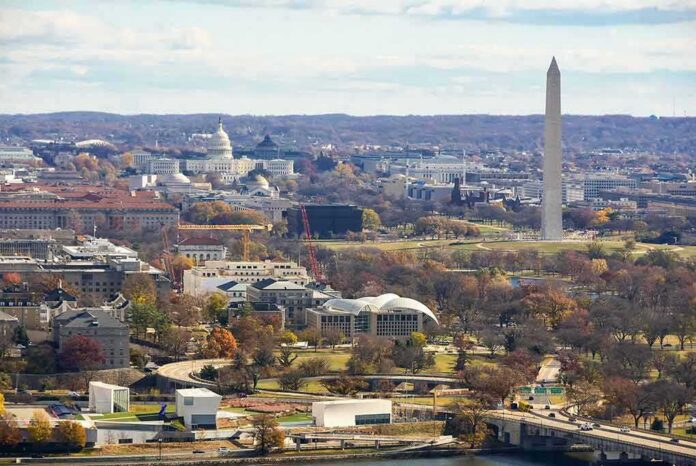
The National Park Service reviewed the proposed arch as part of a legal process meant to protect historic places and views. Its assessment says the 250‑foot structure would “adversely affect” 37 historic sites in and around Washington, including the Lincoln Memorial, Arlington National Cemetery, and the Washington Monument. In plain terms, the agency believes the arch would crowd the skyline and change key sightlines that now connect these places. It also warned that the new structure would alter the meaning of the ceremonial route from Arlington into the city.
The Park Service mapped an “area of potential effects” that stretches along Memorial Avenue, the Lincoln Memorial, and the National Mall. That corridor carries deep symbolic weight, linking graves of fallen service members with the statue of Abraham Lincoln and the open space where Americans gather to protest and celebrate. The arch would sit right in this path, at Memorial Circle near the foot of Arlington Memorial Bridge, creating a new focal point between cemetery and city. For many critics, that placement feels like inserting politics into a space meant to honor sacrifice and shared history.
How big the arch is — and why that matters
Current plans call for a stone and granite arch that would rise about 250 feet into the air, with a large golden statue and viewing platform near the top. That would make it more than twice as tall as the Lincoln Memorial, which is under 100 feet, and higher than the dome of the United States Capitol. Only the Washington Monument would stand clearly above it. Supporters say the height matches the 250th anniversary of American independence and would create a bold new symbol for visitors arriving from Virginia.
Opponents respond that size is exactly the problem. They argue a triumphal arch of that scale would dominate views that now center on shared national icons, not on any one leader. Some architects and preservation advocates warn that the arch would visually “sever” the line between Arlington National Cemetery and the Lincoln Memorial, replacing a quiet conversation between those two sites with a single massive structure. Lawsuits filed in federal court go further, claiming the project would cause “irreversible damage” to a historically protected area and must be stopped unless Congress clearly authorizes it.
The legal and political fight over height and authority
The National Capital Planning Commission, a key federal body that reviews major projects in the capital region, has already approved preliminary site and building plans for the arch. At the same time, its professional staff urged changes so the design would comply with Washington’s Height of Buildings Act, a law that generally caps structures at 130 feet. Instead of settling the issue, commissioners postponed a final decision on height, creating a gray zone where construction planning can move forward while basic rules remain in dispute.
Trump‑aligned officials now argue that the Height of Buildings Act was never meant to apply to federal projects like this one. A memo from the Department of the Interior claims the statute should be treated more like a local zoning rule and that federal construction is exempt. Members of Congress from both parties have pushed back, sending letters warning that agencies have “no power” to build a triumphal arch on this site without a specific act of Congress. Their argument leans on the Commemorative Works Act and other laws that normally require Congress to pick sponsors and set conditions for new memorials on federal land.
What this reveals about power, process, and public trust
Park Service officials opened a public comment period and say they received hundreds of responses on the arch plan. Reports from one design hearing suggest that almost all of the comments opposed the project, yet the U.S. Commission of Fine Arts, whose members were appointed by President Trump, still approved the design. That gap between public input and federal action has fueled anger on both the left and the right, where many already believe Washington’s agencies listen more to political bosses and wealthy insiders than to ordinary citizens.
BREAKING: “UGLIFICATION!” New report from the National Park Service warns that Trump’s massive golden arch would negatively affect 37 historic sites in Washington DC.
The National Park Service just confirmed what critics have been screaming for months: Donald Trump's obsession… pic.twitter.com/L9Vpsm6D7z
— Occupy Democrats (@OccupyDemocrats) August 3, 2026
For conservatives who worry about federal overreach and elite symbolism, a giant taxpayer‑linked arch framed around one man’s legacy looks like the opposite of limited government. For liberals who fear “America First” projects that ignore community voices and historic context, the effort to weaken preservation rules and rush the arch deepens mistrust. Together, the fight over this structure shows how rules meant to protect shared spaces can be bent or challenged when powerful players want their mark on the map. The real question is whether the capital’s core landmarks are still guarded by neutral standards, or whether those standards now shift with whoever holds power.
Sources:
independent.co.uk, yahoo.com, npr.org, apnews.com, nytimes.com, reuters.com, cnn.com, washingtonpost.com, wjla.com, pbs.org, dcnewsnow.com
© nationalusnews.com 2026. All rights reserved.