
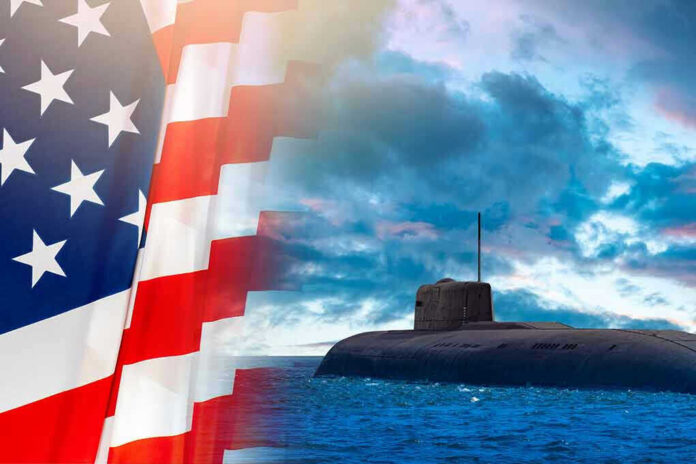
The U.S. Navy’s ambitious SSN(X) stealth submarine project faces severe delays, raising concerns about national security amid global threats.
Story Highlights
- The SSN(X) submarine program’s first procurement is delayed to the early 2040s.
- The program faces budgetary and industrial limitations despite a $222.8 million R&D request.
- Rising costs and congressional uncertainties threaten U.S. undersea superiority.
- China’s faster submarine production exacerbates the U.S. military’s strategic challenges.
Delays in the SSN(X) Submarine Program
The U.S. Navy’s SSN(X) project, envisioned as the next generation of nuclear attack submarines, is experiencing significant delays. The program, initially set for procurement in the mid-2030s, has now been pushed back to the early 2040s. The delay stems from industrial base limitations, rising costs estimated between $6.7 and $8 billion per submarine, and congressional uncertainties regarding capabilities and budgets. These setbacks are a severe blow to U.S. efforts to maintain undersea superiority against emerging threats from China and Russia.
The U.S. Navy’s $8 Billion SSN(X) Stealth Submarine Is Now a Giant Headachehttps://t.co/Jntbi6oizG
— 19FortyFive (@19_forty_five) January 25, 2026
The Navy’s FY2026 request for $222.8 million in R&D highlights the program’s ongoing challenges. Despite the funding, the SSN(X) remains in the concept design and risk-reduction phase. The project aims to integrate advanced technologies such as electric drives, sophisticated sensors, and unmanned underwater vehicles (UUVs) to counteract the accelerating production of submarines by China, which outpaces the U.S. at a rate of two to 1.4.
Challenges and Reform Efforts
The broader context of delays in the SSN(X) program reflects systemic issues within the Department of Defense’s acquisition processes. The program’s struggles underscore the need for reforms, as advocated by Secretary of Defense Pete Hegseth. The current bottleneck at the country’s only two nuclear submarine shipyards, General Dynamics Electric Boat and HII Newport News, adds to the complications, necessitating stable funding and capacity enhancements.
Congress plays a critical role in funding and oversight, demanding clarity on cost structures and reactor fuel choices, such as low-enriched uranium versus highly enriched uranium. The debate over these choices has nonproliferation implications, further complicating the program’s trajectory.
Strategic Implications
In the short term, the SSN(X) program’s delays could exacerbate existing backlogs in the Virginia-class submarines, impacting undersea readiness. In the long term, if the procurement delay holds until 2040, it could erode the U.S.’s strategic advantage in contested waters, ultimately threatening national security. The financial burden on taxpayers is another concern, with each submarine projected to cost between $6.7 and $8 billion.
The Navy’s ambitious target of maintaining a fleet of 296 to 381 ships is at risk. The program’s delays could slow the growth of the submarine fleet, necessitating a shift to modular and distributed building methods to enhance construction speed and efficiency.
Sources:
The U.S. Navy’s $8 Billion SSN(X) Stealth Submarine Is Now a Giant Headache
U.S. Navy’s Next-Generation SSN(X) Attack Submarine Delayed Until 2040
Navy’s Next-Generation Submarine Program Faces Alarming Delay
The Next-Generation SSN(X) Submarine is Expected to Deliver Greater Capabilities