
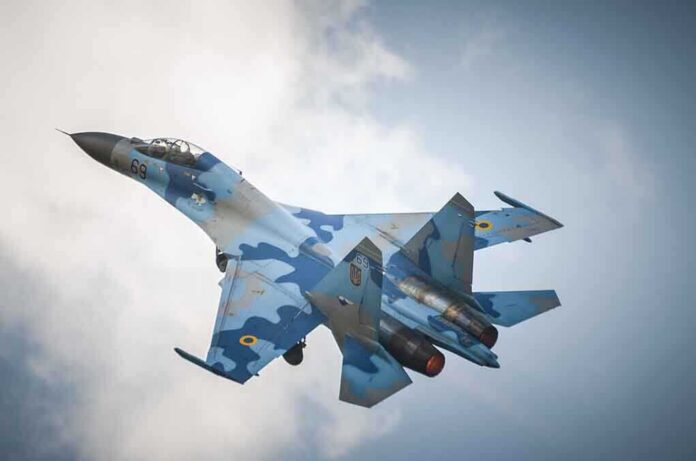
Two F-15EX jets landing in Okinawa is a blunt reminder that America’s Pacific deterrence depends on overwhelming firepower—not Washington talking points.
Quick Take
- Two F-15EX Eagle II fighters have deployed to Kadena Air Base, previewing a larger permanent arrival planned for spring 2026.
- The Air Force is pairing the non-stealth F-15EX with stealth F-35s to combine survivability with high missile and bomb capacity.
- The F-15EX’s new computing and electronic-warfare systems are designed to help identify threats and fight in contested airspace.
- Key performance claims include Mach 2.5 speed and a payload capacity around 29,500 pounds, with air-to-air missile loads varying by configuration.
Kadena Deployment Signals a Pacific-First Operational Shift
The U.S. Air Force has deployed the F-15EX Eagle II to Kadena Air Base in Okinawa, Japan, with two aircraft arriving first as part of the service’s evolving Indo-Pacific posture. Reporting tied the deployment to the Resolute Force exercise and framed the arrival as an early look at a broader transition. Pacific Air Forces has described the move as part of an “airpower evolution,” and multiple sources indicate 36 more F-15EX aircraft are planned to arrive in spring 2026.
Kadena matters because it sits on the front edge of the Western Pacific, where airpower has to be ready quickly and operate with allies. The F-15EX deployment also lands amid continued attention on China’s modern fighter inventory, including J-20 and J-35 platforms referenced in defense coverage. The Air Force’s approach is not presented as replacing stealth aircraft, but as building a mix that can absorb attrition, generate sorties, and carry enough weapons to matter if deterrence fails.
Why the F-15EX Is Being Treated as a “Force Multiplier”
The F-15EX is a next-generation variant of the classic F-15, keeping the familiar shape while adding major internal changes: strengthened structure, digital fly-by-wire controls, and open-systems avionics intended to speed upgrades. Coverage emphasizes the Eagle II’s role as a high-capacity platform that can bring “mass” to a fight—especially when teamed with F-35s. That concept is straightforward: stealth jets can find and survive, while a large-load jet can carry more missiles and strike weapons once targets are identified.
Sources consistently cite headline performance traits: speeds up to about Mach 2.5 and a heavy payload capacity around 29,500 pounds. Missile counts vary across reporting, which reflects real-world configuration choices rather than a single fixed number. Some descriptions highlight a 12-missile loadout, while others cite higher maximums for air-superiority “missile truck” setups. This matters for readers trying to separate marketing hype from operational reality: loadouts depend on mission, drag limits, and the need to carry fuel or other equipment.
Computing, Radar, and Electronic Warfare: The Real Upgrade Path
The most consequential modernization story is not the airframe’s speed but its electronics and growth margin. Reporting highlights a new onboard computing system described as processing 87 billion functions per second, paired with modern sensors and an electronic-warfare suite. Other sources detail the AN/APG-82(V)1 active electronically scanned array radar and the Eagle Passive/Active Warning and Survivability System. Together, these upgrades are meant to improve threat detection, jamming, and survivability in contested environments where an older fourth-generation jet would be outclassed.
The open-architecture approach also speaks to a common frustration Americans have carried from the last decade: bureaucracy that moves too slowly while threats move fast. Open systems are designed to accept new software, sensors, and weapons with less reinvention each time. In plain terms, the Air Force is trying to avoid fleets that become “frozen” because upgrades take too long or cost too much. The research does not provide full cost-per-flight-hour comparisons, but it repeatedly frames the F-15EX as an efficient way to generate combat power.
Hypersonic Compatibility and the Limits of What’s Public
Several sources discuss hypersonic weapon compatibility, including reporting that the F-15EX has been associated with testing connected to the AGM-183 ARRW program. At the same time, the research notes uncertainty around hypersonic fielding timelines and how quickly such weapons can become routine, operational loadouts. For now, what can be stated confidently from the provided material is narrower: the F-15EX is being positioned to integrate advanced weapons as they mature, and its size and payload provide room for future capabilities.
That “prepared for tomorrow” angle also explains why the F-15EX is being sent to the Indo-Pacific early in its operational life. The region demands range, speed, and flexibility, and the Air Force appears to be prioritizing platforms that can scale effects quickly. Still, some key data points vary by source—especially combat range figures—suggesting mission profiles and measurement standards differ. Readers should treat single-number range claims cautiously unless the Air Force specifies the conditions.
What This Means for Deterrence—and for Taxpayers
The immediate impact is deterrence messaging backed by tangible capability: a fast interceptor and strike-capable jet with modern sensors and large magazines operating from a strategically sensitive base. Over the longer term, the F-15EX program reflects a practical mix-and-match approach rather than an all-or-nothing bet on one aircraft type. From a limited-government perspective, that approach can be easier to justify if it delivers measurable readiness without endless reinvention, although the research provided does not include a full cost audit.
87 Billion Functions Per Second: The F-15EX Eagle II is the US Air Force’s New Secret Weaponhttps://t.co/1duhsnFrGi
— 19FortyFive (@19_forty_five) February 11, 2026
In 2026, after years of public frustration with domestic priorities that often felt disconnected from real-world threats, the Kadena deployment stands out for a different reason: it is concrete, measurable, and tied to a mission Americans understand—preventing war by convincing adversaries the cost would be unbearable. The sources portray the F-15EX not as a miracle weapon, but as a high-capacity partner to stealth aircraft. If the planned spring 2026 arrival proceeds, Kadena’s airpower mix will look notably tougher.
Sources:
87 Billion Functions Per Second: The F-15EX Eagle II is the US Air Force’s New Secret Weapon
F-15EX Eagle II Fighter Resumes Production Post-Delays
F-15EX offers first look at Indo-Pacific airpower evolution
The F-15 Eagle and F-15EX Eagle II: Redefining air superiority