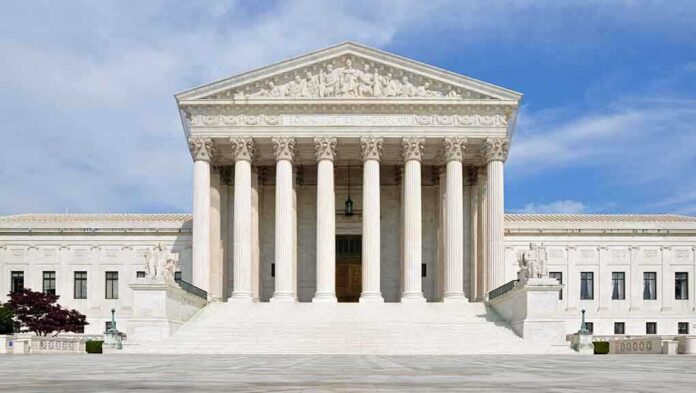
The Supreme Court just gave the president sweeping new control over federal watchdogs, while leaving the country wondering who those watchdogs now answer to.
Story Snapshot
- The Court overturned a 91‑year precedent and let the president fire most independent agency leaders at will.
- Chief Justice Roberts tied real power over regulators to direct presidential control, embracing a unitary executive view.
- President Trump praised the ruling as the biggest boost to presidential power in a century, but critics see a threat to checks and balances.
- Key exceptions like the Federal Reserve Board and an already weakened Federal Trade Commission highlight gaps and risks in the new system.
What Trump v. Slaughter Actually Changed
In Trump v. Slaughter, the Supreme Court ruled 6–3 that the president may fire leaders of most independent federal agencies without showing “cause,” such as neglect or wrongdoing. The decision struck down removal protections for commissioners of the Federal Trade Commission and other bodies, and it explicitly overruled the 1935 case Humphrey’s Executor, which had shielded such officials from at‑will removal. Chief Justice John Roberts wrote that officials who exercise core executive power must be directly answerable to the president through at‑will firing authority.
The ruling did not just focus on one agency. Reporting from major outlets says it reaches “over twenty federal agencies” that long operated with some independence from the White House, including the Federal Trade Commission, National Labor Relations Board, Equal Employment Opportunity Commission, and Consumer Product Safety Commission. These agencies set rules on things like fair markets, workplace rights, and product safety. Under the new rule, presidents can now remove their leaders whenever they choose, without Congress’s older limits.
A President With More Control, But Less Real Power
President Trump quickly celebrated the decision online, calling it the “Greatest Increase in Presidential Power in the last 100 years” and a “Monumental Ruling at such an important time.” Supporters of the ruling argue that when unelected agency heads can block or ignore elected leaders, regular voters lose their voice. They say having one clearly accountable president in charge of the executive branch makes it easier to blame or credit someone when policy fails, instead of fighting a “headless” bureaucracy that answers to no one.
Yet this new control does not guarantee more effective power. The modern administrative state is huge and complex, and most detailed rules still come from career staff and expert commissioners, not from the president directly. Even with at‑will firing, presidents may struggle to track thousands of decisions and may instead focus only on the biggest fights. That means some agencies could still drift or serve well‑connected interests, only now with fewer safeguards against political pressure. Many Americans on both the right and the left already suspect that elites inside government shape policy for themselves. This ruling may confirm those fears if it looks like presidents simply swap one set of insiders for another.
The Rise of the Unitary Executive — And Its Limits
Roberts’s opinion relies heavily on a legal idea called the “unitary executive theory.” This theory says the Constitution places all executive power in the president, so Congress cannot meaningfully block the president’s control over officials who enforce federal law. Over the past decade, the Court has chipped away at removal protections, first for single agency heads and now for multi‑member commissions, turning what were once minority concurring views into binding law. Legal scholars describe this as part of a broader “presidential administration” trend, where courts and presidents together move authority from Congress and agencies toward the Oval Office.
Still, the new decision leaves a major exception. On the same day, the Court treated the Federal Reserve Board differently in Trump v. Cook, allowing its governors to keep “for cause” protection for now. Only two justices, Roberts and Brett Kavanaugh, joined both majorities, and analysts point to tension between a supposed categorical rule and this carve‑out. If the Constitution truly bars Congress from limiting removal of executive officers, it is hard to explain why the Federal Reserve, which makes huge decisions about interest rates and money supply, keeps a special shield. That inconsistency feeds public suspicion that the most powerful financial actors still get special treatment from the system.
What This Means for Agencies, Workers, and Voters
The immediate impact is sharpest at the Federal Trade Commission. After the ruling, only two commissioners remain, both from the president’s party, even though the agency was designed to have five members from both major parties to encourage balance. Fired commissioner Rebecca Slaughter has warned that agencies risk becoming “lap dogs” instead of watchdogs if presidents can replace independent voices with loyalists. Justice Sonia Sotomayor’s angry dissent said the decision “reshapes our government,” undermines expert judgment, and invites politicization of crucial civil service work.
Trump v. Slaughter is a U.S. Supreme Court case argued on December 8, 2025, that examines whether statutory removal protections for Federal Trade Commission members violate the separation of powers.
Overview of Trump v. Slaughter
Trump v. Slaughter is a significant U.S. Supreme…— 🥞sh0rtstack🥞 (@Stack_Jax) July 5, 2026
Media coverage from outlets like Vox, CBS News, and CNN has framed the ruling as making Trump “the most powerful president in generations” and “turbocharging presidential power,” calling it a “sky is falling moment” for the professional bureaucracy. Many conservatives cheer the blow to what they view as an unaccountable “deep state” that pushed globalist, woke, and green energy rules without listening to voters. Many liberals fear the same move will strip protections from workers, consumers, and minorities and hand more leverage to big corporations and wealthy donors. Across the spectrum, however, a common worry appears: a federal government that seems more focused on protecting its own power than on helping ordinary Americans reach the basic promise of the American Dream.
Sources:
theatlantic.com, cbsnews.com, natlawreview.com, vox.com, cdflaborlaw.com, en.wikipedia.org, theconversation.com, youtube.com, lyldenlawnews.com, hls.harvard.edu
© nationalusnews.com 2026. All rights reserved.