
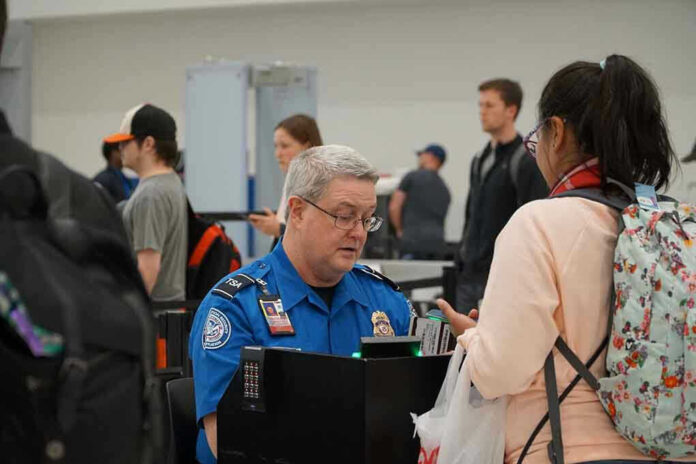
The TSA wants to put your fingerprints and facial scans into a federal database network while handing you a digital ID on your phone—raising serious questions about privacy and government overreach in the name of airport convenience.
Story Snapshot
- TSA proposed MyTSA PreCheck ID on January 15, 2026, as a voluntary mobile digital credential linking biometric data to FBI and DHS databases for airport screening
- The system integrates fingerprints and facial images with federal databases including FBI NGI and DHS IDENT/HART for ongoing security threat assessments and identity verification
- Touchless ID expansion targets 65 airports by spring 2026, starting with six California locations, building on pilots at 15 existing airports
- Privacy concerns emerge as federal agencies consolidate biometric data across multiple government systems despite claims of voluntary participation and 24-hour image deletion
Federal Database Integration Under Voluntary Program
The Transportation Security Administration published a Federal Register notice on January 15, 2026, outlining the MyTSA PreCheck ID proposal, which provisions mobile digital credentials to enrolled Trusted Traveler members. The system requires applicants to submit fingerprints and facial images that feed directly into FBI Next Generation Identification and DHS IDENT/HART databases for security threat assessments. TSA positions this as voluntary enhancement for low-risk travelers seeking expedited screening, but the proposal creates unprecedented biometric data sharing across federal agencies. Comments on the proposal remain open until March 16, 2026, through the Office of Management and Budget review process.
The proposal distinguishes itself from existing TSA PreCheck by provisioning dedicated mobile credentials directly to devices and enabling data sharing across Department of Homeland Security systems without repeated physical document checks. Unlike current Touchless ID pilots requiring physical ID backup and passport uploads, MyTSA PreCheck ID aims to eliminate these requirements through recurrent vetting against criminal, immigration, intelligence, and regulatory databases. This infrastructure builds on the 2005 Aviation and Transportation Security Act establishing voluntary biometric submission for security assessments, but expands federal reach into travelers’ personal devices and consolidates surveillance capabilities under convenience justifications.
Rapid Airport Expansion Planned for 2026
TSA confirmed expansion of PreCheck Touchless ID technology to over 50 airports by year-end 2026, beginning with six California locations: Sacramento, San Jose Mineta, John Wayne, Palm Springs, Long Beach, and San Diego International. The agency targets 65 total airports by spring 2026, building on existing pilots at 15 locations including Atlanta, Boston, Charlotte, Dallas-Fort Worth, and Denver. Airlines including Delta, American, Southwest, United, and Alaska have integrated the system into mobile boarding passes, allowing opt-in through frequent flyer profiles. The aggressive timeline coincides with preparations for the 2026 FIFA World Cup, positioning high-volume events as justification for accelerated biometric infrastructure deployment across American airports.
Current pilots require travelers to maintain physical identification as backup despite facial recognition kiosks at checkpoints, with TSA claiming images delete within 24 hours of capture. The system links Known Traveler Numbers to biometric profiles, creating permanent associations between government-issued credentials and biological identifiers in federal databases. Airport operators face infrastructure investments for specialized lanes and data network upgrades to support the expanded system, costs ultimately passed to travelers through fees and airline ticket prices while benefits concentrate among frequent business travelers already enrolled in premium programs.
Privacy Versus Convenience Trade-Off
The MyTSA PreCheck ID proposal epitomizes the tension between government efficiency claims and constitutional privacy protections that concern many Americans. While TSA frames biometric integration as resource optimization focusing security personnel on higher-risk passengers, the reality involves building comprehensive federal databases tracking citizens’ movements and biological markers. The voluntary nature provides legal cover, but creates two-tier airport access where refusal means longer lines and increased scrutiny—practical coercion disguised as choice. This mirrors broader digital ID initiatives that condition basic services on surrendering biometric data to government systems.
Travel industry representatives praise shorter checkpoint lines for business travelers, yet raise flags about privacy and data retention requirements in vendor contracts managing sensitive biometric information. The system enables future expansion beyond airport screening to sterile area visitor passes and other access controls, incrementally normalizing biometric checkpoints throughout American infrastructure. For citizens valuing limited government and personal privacy, MyTSA PreCheck ID represents another step toward surveillance infrastructure that, once built, rarely dismantles regardless of future administrations’ intentions. The Federal Register notice’s bureaucratic language obscures the fundamental question: whether convenience justifies permanent biological identification records in federal hands.
Sources:
TSA Touchless ID Heads to Six More California Airports with 50-Airport Rollout Slated for 2026
TSA Expanding PreCheck Touchless ID to 50 New Airports
TSA Large Expansion Touchless ID 2026