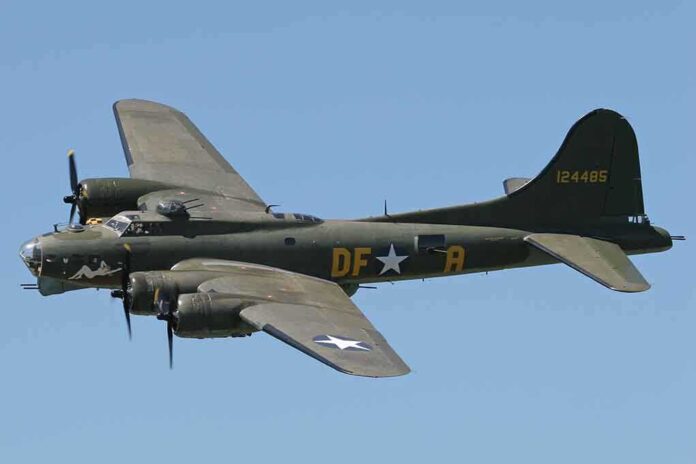
A $2 billion contract extends B-52 bombers’ service life, ensuring American air superiority for decades.
Story Highlights
- The US Air Force awarded Boeing a $2.04 billion contract to modify and test two B-52 bombers.
- This initiative is part of the B-52 Commercial Engine Replacement Program (CERP) aimed at extending the aircraft’s service life.
- The re-engining project addresses the obsolescence of the current TF33 engines, unsustainable by 2030.
- The program supports strategic deterrence by ensuring the B-52 is operational into the 2050s.
Major Contract Awarded to Boeing
On December 23, 2025, the US Air Force announced a substantial $2.04 billion contract awarded to Boeing Defense Systems, marking a pivotal step in the modernization of the iconic B-52 bombers. This task order involves the Commercial Engine Replacement Program, focusing initially on modifying and testing two B-52H aircraft with new Rolls-Royce F130 engines. This phase targets the post-Critical Design Review development, underscoring the commitment to extending the aircraft’s operational life into the 2050s.
The contract is a decisive move to address the obsolescence of the B-52’s current Pratt & Whitney TF33-PW-103 engines, which have been in service since the 1960s. With manufacturing and sustainment issues making them unsustainable by 2030, the transition to Rolls-Royce F130 engines promises enhanced reliability and fuel efficiency. This initiative aligns with the Air Force’s strategic objective to maintain its nuclear and conventional capabilities, ensuring that the B-52 fleet remains a cornerstone of American air superiority.
Strategic Importance of the Re-Engining Program
The re-engining of the B-52 fleet is not just a technological upgrade; it is a strategic necessity. The program is set to enhance the aircraft’s range, loiter time, and electrical power, enabling new weapon integrations. The integration of AESA radar and other modernization efforts further complement these upgrades, designating the updated aircraft as the B-52J. As global tensions rise, this initiative is a clear message of deterrence, reinforcing the US Air Force’s commitment to maintaining a robust and reliable long-range bomber fleet.
Beyond the immediate technical benefits, this program supports thousands of American jobs across multiple states, including Oklahoma, Texas, Washington, and Indiana, where Boeing’s operations are centered. Such contracts bolster local economies and contribute to the broader aerospace industry, setting a precedent for future modernization of legacy aircraft.
Implications and Future Outlook
The short-term focus on two aircraft serves as a precursor to fleet-wide modernization, with completion expected by May 31, 2033. The successful integration of the F130 engines will validate the path forward for the entire fleet, ensuring these aircraft remain operationally viable into the 2050s. For the Air Force, this means sustained capability to project power and conduct strategic missions without interruption.
The broader implications of this program are significant, reinforcing the US’s strategic bomber deterrence capabilities amid global uncertainties. As the project progresses, it will be crucial to monitor its economic and political impacts, ensuring that American defense posture remains strong and resilient in an ever-changing world.
Sources:
USAF Awards Boeing $2B Contract for B-52 Re-Engining Program
Boeing Awarded $2 Billion Contract for B-52 Engine Replacement
Boeing B-52 Port San Antonio Pentagon $2B Contract
Boeing to Re-Engine B-52 Fleet to Extend Service Life