As wildfires in southwest France force more than 220,000 people to flee, British holidaymakers are driving straight toward the smoke, hoping the system somehow still works for them too.
Story Snapshot
- Massive wildfires in southwest France have pushed evacuations over 220,000 people in the Gironde region alone.
- British tourists on driving holidays and campsite stays have been caught in the chaos, scrambling to change plans or travel through smoke-filled motorways.
- Heat, drought, and slow government planning turned a known risk zone around Bordeaux and Arcachon into a disaster, raising questions about how leaders prepare for obvious threats.
- The crisis highlights deeper worries on both left and right about stressed infrastructure, climate extremes, and governments that seem quicker to hold press conferences than to fix root problems.
Wildfires Turn A Tourist Region Into An Evacuation Zone
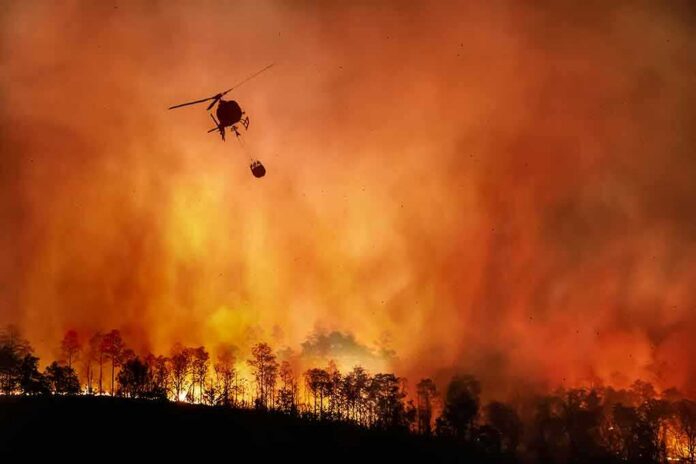
French authorities say wildfires in the Gironde region around Bordeaux have forced about **220,000 people** from their homes and holiday rentals, with more evacuations still possible as winds shift. Officials report that a huge blaze near Cap Ferret and Arcachon has burned roughly **42,000 hectares**, an area several times the size of Paris, driven by weeks of heat and drought. These fires have turned popular beaches, wine villages, and campsite strips into emergency corridors, with convoys of cars trying to outrun advancing smoke.
Farther south, another fire in the Landes department has pushed the regional evacuation total above **250,000 people** in southwest France, as scattered communities and tourist areas are cleared before flames reach homes. Emergency crews describe multiple active fronts, some jumping long distances when winds pick up, making it hard to promise anyone that their town is truly safe. For local families and visitors alike, simple summer plans have become a rolling gamble about which road stays open and which village will get cleared next.
British Travellers Caught Between Holiday Plans And Hazard Maps
British travellers, especially those who drive to France or book budget campsites, are in the middle of this crisis in a very practical way. Reports from local media and travel outlets say Britons were among thousands fleeing seaside holiday parks as fires tore through parts of southern France, destroying hundreds of mobile homes and holiday chalets. Many others are pressing on with planned trips, watching news about evacuation zones near Bordeaux and Cap Ferret while hoping their chosen gîte or caravan site is not on the next clearance list.
Drivers heading from northern ports toward the Spanish border now face long detours, thick smoke in some stretches, and sudden closures as police redirect traffic away from threatened forests. Tourists with limited budgets must decide whether to cancel outright, absorb extra fuel and hotel costs, or camp farther from fire zones that still sit under haze. For ordinary travellers, this feels like another example of how fragile basic mobility has become, as one shock after another reveals how thin the margin of safety is for anyone who is not wealthy or well-connected.
Why Southwest France Is So Vulnerable — And What That Signals
Fire experts note that the Bordeaux and Arcachon area is a textbook risk zone: dense pine forests, dry scrub, heavy tourist traffic, and a warming climate that brings more heat waves and longer droughts. French officials say nearly **100,000 hectares** have burned nationwide this year, along with dozens of separate fires active at once, a scale they link to hotter summers and stressed ecosystems. Yet much of the built environment in these regions—roads, power lines, crowded campsites—was planned for a calmer past that no longer exists.
Residents across France and Spain now see repeated evacuations, smoke-choked cities, and emergency meetings as “normal,” even as governments still speak of these fires as unexpected events. Many on both the left and right feel this is the pattern in crisis after crisis: leaders talk about resilience, but basic protections lag behind reality, and everyday people eat the costs. When half a million people can be displaced in a matter of days by fires near major cities and tourist hubs, it raises hard questions about how seriously officials take long-known threats.
Numbers, Confusion, And Growing Public Distrust
Evacuation counts have bounced from 10,000 to 55,000 to over 220,000 and then above 250,000 as separate fires and departments are added into the tally. This shifting math reflects a fast-moving emergency, but it also feeds public doubt, because families see headlines change day to day without clear maps showing who was moved, where, and for how long. Many wonder whether the big numbers show unique people or repeated relocations, and feel that reporting and official briefings still speak more in slogans than in hard, transparent data.
"Firefighters and volunteers raced to contain wildfires on Monday. The crisis has forced hundreds of thousands to evacuate in central Spain and southwest France." https://t.co/KfsXNUQ4hD @nytimes
— Christina Ayiotis, Esq., CRM, CIPP/E, AIGP (@christinayiotis) July 27, 2026
For French citizens and foreign tourists alike, the wildfires tie into a larger sense that modern governments struggle to handle basic duties—protect land, manage forests, keep roads open, and share clear facts when danger comes. People who already worry about elites, distant bureaucracies, and neglected infrastructure see these fires as one more sign that the system is reactive, not prepared. British travellers driving toward the smoke are not just chasing sun; they are stepping into a live test of whether European institutions can still keep ordinary families safe when nature pushes back this hard.
Sources:
independent.co.uk, bbc.com, reuters.com, youtube.com, nytimes.com, aljazeera.com, euronews.com, connexionfrance.com
© nationalusnews.com 2026. All rights reserved.