
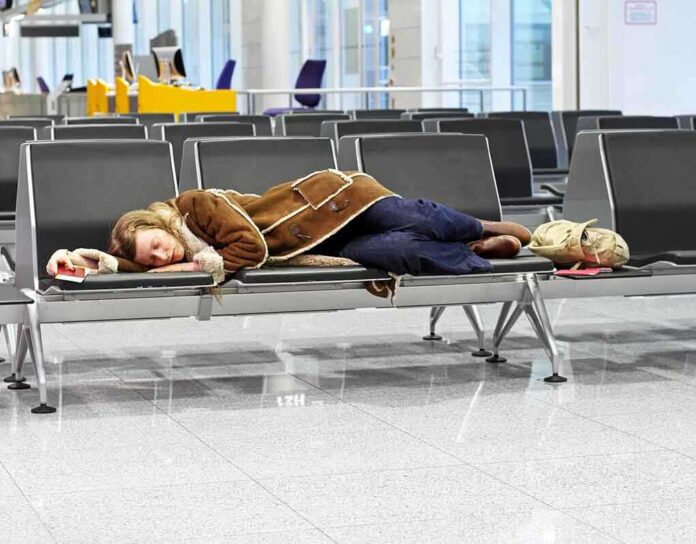
Americans are now being told to show up to airports three to four hours early—because a partial DHS shutdown has reportedly left TSA screening understaffed right as spring break crowds surge.
Quick Take
- Reports say TSA checkpoint waits have stretched to as long as four hours at some U.S. airports during peak spring travel.
- Airport warnings and news coverage link the delays to TSA staffing shortages tied to a partial government shutdown.
- Houston Hobby imposed a ground stop amid heavy passenger volume and lengthy security lines, illustrating how quickly backups can cascade.
- Historically “bad” airports average wait times measured in minutes—not hours—showing how far today’s disruption has drifted from normal operations.
Shutdown-Driven Staffing Strain Collides With Spring Break Crowds
News reports dated March 9, 2026 describe TSA security lines ballooning to three and even four hours at multiple airports as spring break travel ramps up. The cited driver is a TSA staffing shortage connected to a partial government shutdown affecting the Department of Homeland Security. Airports have pushed travelers to arrive far earlier than normal, a major shift from the usual expectation that security is an inconvenience measured in minutes, not half a workday.
The immediate problem for families and older travelers is basic: airports and airlines run on fixed departure times, but security throughput becomes the bottleneck when staffing drops. When screening lines slow, crowds stack up in terminals, gate areas fill, and customer service lines back up too. The research does not include a precise count of absent TSA personnel or a clear shutdown timeline, which limits what can be concluded beyond the widely reported connection between staffing shortfalls and delays.
Ground Stops and Local Warnings Show How Fast the System Breaks
The disruption has not been theoretical. Houston’s William P. Hobby Airport reportedly issued a ground stop because passenger volume overwhelmed the system while travelers faced roughly three-hour waits to clear security. Reports also cite extended delays at Louis Armstrong New Orleans International Airport and warnings at other hubs. That matters because a ground stop can ripple outward: late arrivals disrupt aircraft rotations, crews time out, and connecting passengers miss onward flights, multiplying the frustration across the network.
Airports and TSA commonly publish “arrive early” guidance, but the contrast here is stark. Several airport sources and past TSA/airline recommendations typically point to about 90 minutes for domestic trips and around two hours for international departures, with major airports like Denver advising at least two hours. Being told to budget three to four hours effectively forces travelers to treat routine domestic flying like an international departure, and that change carries real costs in time, childcare, and missed work.
Normal TSA Wait-Time Data Highlights How Extreme the Spike Is
Historical wait-time data underscores how abnormal multi-hour lines are. One travel-data roundup lists Newark Liberty’s average security wait around 23 minutes, with other large airports like Houston’s George Bush Intercontinental and Miami averaging under 20 minutes. Even if travelers know certain hubs are “always bad,” those averages still describe a functioning system. Jumping from typical 10–25 minute experiences to 180–240 minutes is not a small delay—it’s a breakdown in capacity.
Airport operations data also shows crowding is predictable. Seattle-Tacoma, for example, publishes checkpoint estimates and notes that a large share of passengers arrive before 9 a.m., with additional peaks later in the day. Spring break amplifies those peaks, and a staffing shock makes them harder to manage. The research does not provide direct statements from TSA leadership or DHS officials, so the public is left with airport advisories and media reporting rather than a clear federal plan for restoring normal throughput.
What Travelers Can Do While Washington Sorts Out the Basics
For now, the most practical takeaway is that travelers should treat airport guidance as operational reality, not optional advice. If an airport is warning of three- to four-hour waits, arriving “like normal” becomes a gamble with your ticket and your schedule. Real-time checkpoint estimate pages can help, but they are not guarantees when staffing is volatile. Until the shutdown-related staffing issue is resolved, the safest assumption is that screening capacity may not match demand.
https://twitter.com/FoxNews/status/2031349461159395330
The broader lesson is about government competence and priorities. Transportation security is a core federal function tied to national infrastructure and public safety; when funding fights or shutdown mechanics disrupt staffing, ordinary Americans pay the price in wasted hours and missed plans. The available reporting ties today’s delays to shutdown-driven shortages, but it still lacks specifics on scope and duration. That gap is exactly why transparent DHS and TSA communication—and fast restoration of normal operations—matters.
Sources:
Average TSA Security Wait Times at U.S. Airports
San Antonio International Airport Security Checkpoints Wait Time
Denver International Airport Security
Live Estimated Checkpoint Wait Times (Port of Seattle)
BWI Airport Security and TSA Guidelines
Wait Times at US Airports Skyrocket as Shutdown-Related TSA Absences Climb