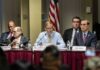

SNL turned a boardroom crisis at the world’s top AI chipmaker into a punchline, underscoring how a CEO’s private life can rattle markets and national security debates at once.
Story Highlights
- Nvidia said CEO Jensen Huang resigned effective immediately and launched an independent investigation.
- Reports described alleged affairs and a separate claim that Huang was targeted by foreign intelligence.
- SNL’s sketch signaled the scandal’s jump from finance pages to mainstream culture.
- Official statements did not name a cause for the resignation, keeping key questions open.
What Happened: Resignation and Board Investigation
Nvidia announced that Jensen Huang resigned as president, chief executive officer, and board member, effective immediately. The company said its board started an independent investigation after reporting that Huang had been the target of a foreign intelligence effort. The statement praised Huang’s contributions but did not give a reason for his exit. Colette Kress, the chief financial officer, was named interim leader in media coverage, while the company’s release focused on the probe and transition details.
The Associated Press reported that Nvidia had first said Huang would remain as chief executive during an internal review before the board accepted his resignation. The wire service also noted that the company’s Thursday announcement did not address reports about alleged relationships. That sequence left the public with an abrupt change at a firm that drives much of today’s artificial intelligence hardware and holds huge sway over markets and supply chains.
The Allegations: Affairs, Power Lines, and Spy Fears
Reuters reported that Nvidia’s board weighed Huang’s future after stories about alleged extramarital affairs surfaced, including one involving an executive who reportedly reported to him. The outlet framed it as a deepening leadership crisis with market implications, given Nvidia’s dominant position in advanced chips. The reporting relied on unnamed sources, which strengthens urgency but limits outside verification of who did what, when, and whether policy lines were crossed inside the company.
Mediaite and other outlets said Huang admitted to being unfaithful in a note to employees and apologized to his family, confirming infidelity in his own words. Separate coverage highlighted a claim that one alleged partner was suspected by United States intelligence of spying for Beijing, while Beijing denied the claim. The available record does not show an official finding that Huang knowingly aided espionage, and no public charging documents or declassified assessments have been produced supporting that claim.
From Boardroom to Pop Culture: Why SNL’s Skit Matters
Saturday Night Live’s cold open featured a portrayal of Huang and jokes about whether women approaching tech leaders were real partners or spies. That bit showed the story had escaped the business pages and entered shared culture, where complex issues get compressed into tags and laughs. Mediaite’s recap captured the thrust of those jokes and their link to the week’s headlines about the resignation and the alleged affairs connected to it.
Cultural amplification can blur lines between distinct issues: private conduct, potential workplace power imbalance, and national security. When a late-night skit treats them as one tale, viewers may assume all parts are proven, even if official statements remain narrow. That dynamic feeds a cycle where rumor, risk, and reputation push boards to act fast, while the public receives partial facts and satire at the same time.
What We Know—and What We Do Not
Public records confirm a few key facts. Nvidia announced the immediate resignation and an independent investigation tied to a reported foreign intelligence targeting. Major outlets reported alleged affairs, and one said a partner was a direct report. Huang acknowledged infidelity. But the company has not said the affairs caused the resignation. Without board minutes, investigation findings, or securities filings that spell it out, causation remains unproven in the public record.
Bowen Yang Returns to ‘SNL’ as Jensen Huang as John Mulaney’s Cold Open Mocks Nvidia Scandal, National Ground Stop and Outlook Outage https://t.co/WdyMBSNIyg
— Info Reader (@InfoReaderNews) November 15, 2026
This gap frustrates people across the spectrum. Many on the right see another tech giant that plays by its own rules. Many on the left see power protecting power while workers and shareholders carry the risk. Both camps worry that elites in big firms and in Washington close ranks when the stakes are high. That concern deepens when a national security thread gets raised but not documented in public view.
Why This Matters for Markets and Governance
Nvidia sits at the center of the artificial intelligence race. Any leadership shock there can shake stock indexes, supply plans, and research timelines. Investors want clarity on guardrails around executive conduct, reporting lines, and compliance checks. Harvard governance research shows boards must probe credible misconduct and can respond in many ways short of removal. That nuance is often lost when a crisis goes viral and satire sets the tone.
Clear answers now depend on process. If the board’s investigation produces public findings, shareholders and employees can judge whether policy, ethics, or security lines were crossed. If not, the vacuum will be filled by memes and market swings. For a nation already split and tired of elite double standards, basic transparency from powerful institutions—corporate and governmental—remains the only path to trust.
Sources:
© nationalusnews.com 2026. All rights reserved.