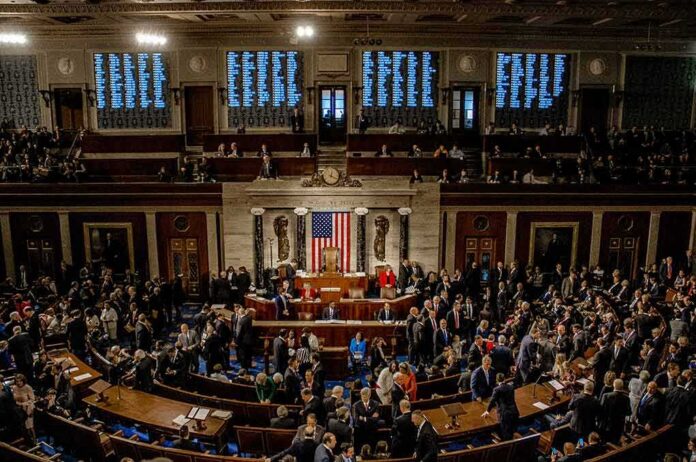
South Carolina’s Senate seat has already changed hands, but the bigger fight is over whether Lindsey Graham’s final policy push will become law.
Quick Take
- Lindsey Graham’s death created an immediate Senate vacancy in South Carolina and triggered a fast replacement process under state law.
- Governor Henry McMaster appointed Darline Graham Nordone to serve the rest of the term until January.
- Reporting says Graham had just pushed a Russia sanctions package and tied it to Ukraine policy before he died.
- The record shows the vacancy and the legacy debate clearly, but not any final Senate action on the sanctions bill.
A Senate seat with immediate consequences
Lindsey Graham’s death set off a rapid series of changes in South Carolina and Washington. State law allowed Governor Henry McMaster to appoint a temporary replacement, and McMaster chose Darline Graham Nordone to serve out the rest of the term. News reports also say a special election process is now underway, with the Senate seat tied to both the November ballot and the state’s fast-moving primary calendar.
The practical effect goes beyond one name on a roster. Graham chaired the Senate Budget Committee and held seats on major committees, so his absence altered both the chamber’s arithmetic and its work load. Reuters reported that the appointment helped restore the Republican majority in the Senate, while other reports noted that his death left a leadership gap at a time when Congress already had a crowded agenda.
Graham’s final push on Russia policy
The strongest policy thread in the available reporting is Graham’s effort on Russia sanctions. NBC News said he had been pressing sanctions on Russian oil to cut funding for Vladimir Putin’s war in Ukraine, and ABC News reported that he announced a sanctions-package agreement with the Trump administration two days before his death. That makes the bill look less like a random tribute project and more like a direct extension of work he was already pursuing.
Reporting also places Graham in active Ukraine diplomacy right before he died. One source says he had just returned from Kyiv and urged the United States to help Ukraine become “more lethal” while finding an end to the war that would not humiliate Russia. That context matters because it shows why allies quickly framed the sanctions bill as part of his foreign-policy record, not just as a symbolic gesture after his death.
Legacy talk outpaces the paper trail
The gap in the record is the bill itself. The supplied sources do not include the full text of the Sanctioning Russia Act of 2025, a committee report, or a floor schedule showing that the Senate advanced it after Graham died. They also do not include Mike Turner’s exact quoted statement, even though later coverage uses his name to connect passage of the bill to Graham’s legacy. That leaves the strongest claims still partly dependent on summary reporting.
South Carolina Russell Fry (establishment candidate) is dual-candidating for U.S. House (SC-07 re-election) and the special Republican primary for the Senate seat left open by Lindsey Graham’s death. He keeps the House ballot line as a fallback. If he wins the Senate, he vacates… pic.twitter.com/YeUdvWnCmY
— Jungleball2 (@JungleBall_2) August 8, 2026
That missing paper trail is why the story has two layers at once. On one level, South Carolina is dealing with a normal but urgent vacancy process: temporary appointment, special primary, and a November election fight. On another level, Graham’s allies are trying to turn his last foreign-policy push into an inherited cause. For readers frustrated by Washington’s habits, the episode shows how fast politics shifts from governing to memorial framing when a powerful senator dies.
Sources:
cbsnews.com, cnn.com, reuters.com, usatoday.com, en.wikipedia.org, kcra.com, nbcnews.com, pbs.org
© nationalusnews.com 2026. All rights reserved.