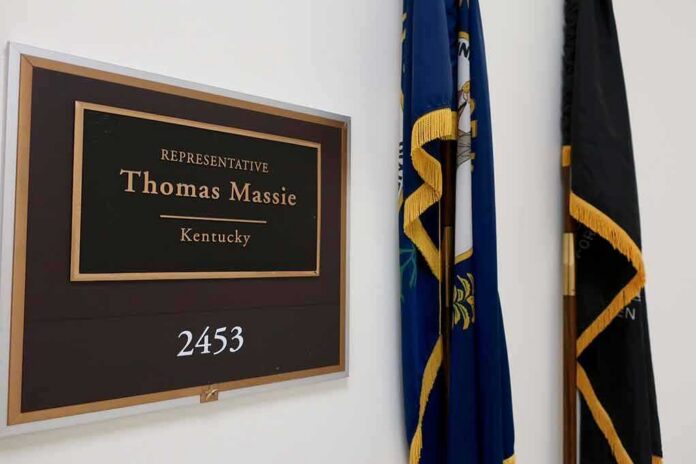
House leaders ended session early as Rep. Thomas Massie pushed an impeachment vote against Defense Secretary Pete Hegseth over alleged unlawful wars.
Story Snapshot
- Rep. Thomas Massie filed eight impeachment articles against Pete Hegseth over alleged unauthorized hostilities.
- Speaker Mike Johnson called it a stunt and ended session early, delaying any vote.
- The dispute revives the core fight over who decides war: Congress or the executive branch.
- Both parties’ voters see a system that shields insiders and dodges hard questions.
What Massie Filed And Why It Matters
Representative Thomas Massie introduced eight impeachment articles against Defense Secretary Pete Hegseth. The filing accuses Hegseth of abusing his office by directing hostilities against Iran without approval from Congress, in violation of the Constitution and the War Powers Resolution. Massie’s materials also describe alleged unlawful actions tied to Yemen and Venezuela, including an operation to seize former Venezuelan leader Nicolás Maduro, claims that raise sharp legal and policy questions about limits on military force. The move forces a public test of war powers.
Massie used a privileged path to press for a swift House vote. The articles, read on the House floor, cite “high crimes and misdemeanors” anchored in unauthorized wars and civilian harm rules. Massie says he weighed the step for months. The effort is unusual because it targets a top national security official from the same party as House leadership and the White House. That makes the clash more than partisan theater. It is about whether Congress will assert its authority to declare war.
How House Leaders Responded And What It Signals
House Speaker Mike Johnson dismissed the effort as a “publicity stunt” and warned against “playing games with national security.” He said the House would table it and instead recessed early, canceling planned votes and delaying any decision until after the midterms. That move protected floor time and avoided a divisive vote inside the majority. It also denied members a recorded stance on war powers before voters cast ballots. Leadership control of the calendar again decided substance through procedure.
Cutting the session short highlights a familiar pattern in Congress. Members can raise impeachment as a privileged question, but leaders often steer timing to blunt its impact. House rules and precedents give leaders major leverage over the schedule, even when a resolution is privileged, by adjourning or structuring floor debate windows. The result is a recurring tug-of-war: rank-and-file members try to force accountability votes, while leadership prioritizes unity and agenda control.
The Core Constitutional Fight: War Powers And Accountability
Massie’s filing spotlights a basic question: who authorizes war? The Constitution gives Congress the power to declare war, while the President, and by extension the Defense Secretary, directs the military. The impeachment articles argue Hegseth crossed the legal line by initiating and escalating hostilities without Congress. That claim, if accurate, would cut to the heart of shared concerns on the right and left about leaders bypassing the law and the people’s representatives to wage open-ended conflicts.
Supporters of swift executive action often say threats require speed and secrecy. Critics respond that speed is not a blank check, and the War Powers Resolution exists to keep wars accountable to voters through Congress. The House’s early recess means those arguments did not get a full, on-the-record airing this week. Voters who worry about endless wars, civilian harm, and mission creep see another example where process blocked a deeper debate they want and deserve.
Why This Resonates With Fed-Up Voters Across The Spectrum
Conservatives who oppose “forever wars” and liberals who resist unchecked force can read the same headline and feel the same chill. A member raised serious claims about illegal hostilities. Leadership closed shop and sent everyone home. That does not prove the claims are true. It does suggest that Congress still struggles to police war decisions made by the executive branch. Many Americans believe that when the stakes are highest, insiders protect insiders and the public gets no straight vote.
This video reports that House Speaker Mike Johnson is ending the legislative session early, sending lawmakers home for a seven-week midterm campaign recess (0:00-0:03).
Key takeaways:
Impeachment Delay: The early departure effectively delays a forced vote on the impeachment of…— Wandafay (@Wandafay) September 17, 2026
Two things can be true at once. First, impeachment is a grave step, and evidence must be tested. Second, the House owes the country a transparent process and a timely vote. Leadership says national security should not be a political game. Many citizens answer that the most political game is dodging a vote. The path forward is simple: take up the resolution, debate the facts in daylight, and let members stand and be counted. That is how trust is built, or lost.
Sources:
yahoo.com, insidedefense.com, wtop.com, en.royanews.tv, abcnews.com, pbs.org
© nationalusnews.com 2026. All rights reserved.