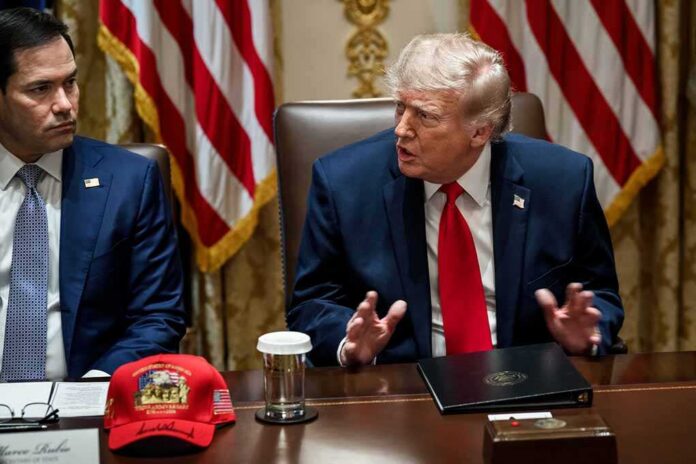
President Trump praised Flock’s license-plate cameras as crime-fighting tools even as courts and watchdogs warn the system can track everyone, not just suspects.
Story Highlights
- Trump voiced support for Flock cameras amid a national fight over safety versus privacy.
- Flock reports large crime-solving gains, including support for over 1 million investigations.
- Courts in Washington ruled Flock images are public records, fueling transparency battles.
- Civil-liberties groups say warrantless searches risk mass surveillance and abuse.
Trump’s Comment Lands in a Live National Policy Fight
President Trump said he likes Flock’s surveillance cameras, putting White House attention on a tool now used by thousands of agencies. The comment aligns with a push for tougher policing during rising concerns about theft and violent crime. Supporters in law enforcement argue the cameras help find stolen cars, identify suspects, and recover missing people. Critics argue the same network can log the movements of everyone who drives past, with little judicial oversight. Both claims shape the policy stakes.
Flock’s business model centers on fixed cameras that read license plates and send alerts based on police hotlists. Cities and counties can also search historical scans. The company says the value grows as more cameras and jurisdictions connect. That scale is exactly what alarms privacy advocates. They warn that large, shared databases can reveal patterns about where people worship, seek medical care, or meet, even when they are not suspected of crimes. Courts and lawmakers are now catching up to these risks.
What the Data Says About Crime and Case Solves
Flock cites its 2025 Impact Census to claim the system supported more than 1 million investigations, aided in solving 20 percent of cleared cases, and helped find over 10,000 missing people. A separate analysis associated more cameras with higher clearance rates for typical agencies, suggesting a measurable lift on solved cases. Flock also markets an estimate that about 700,000 crimes a year involve its technology, or around 10 percent of reported crime, though that figure comes from the company’s own methodology.
Peer-reviewed and independent research on long-term outcomes is still developing. Early work using data from hundreds of agencies tied camera rollouts to an 11 percent drop in vehicle thefts and higher clearance rates in those communities. Local case studies tout large local gains, though results can vary across neighborhoods and time. Supporters say this proves cameras are a force multiplier. Skeptics counter that company claims should be tested by independent audits, not vendor reports alone.
Courts Push Transparency While Cities Test Limits
Judges in Washington state ruled that Flock-generated images are public records under state law, even if departments never download the files. That decision forced agencies to release images and logs upon request, expanding public oversight of how cameras are used. News outlets and advocates reported follow-on settlements and city policy pauses as local leaders wrestled with retention limits, access, and the cost of compliance with records laws. The rulings widened a local but influential legal path.
Elsewhere, lawsuits and policy fights continue. A federal judge in Virginia allowed a challenge to a city’s camera network to proceed while finding that automated license plate readers do not, by themselves, invade privacy under federal law at this stage. The Institute for Justice’s suit against Norfolk’s system is moving forward after the court blocked Flock’s late bid to intervene, keeping the focus on government use rather than the vendor’s role. These mixed outcomes show a patchwork of legal rules.
Privacy Groups Warn of a Growing, Warrantless Dragnet
Civil-liberties groups argue the core risk is warrantless, bulk collection. They say officers can query scans of drivers who are not suspects, creating a searchable record of daily life. The American Civil Liberties Union criticized Flock’s new “guardrails,” saying they do not fix the lack of a warrant standard for searches of historical data. Some critics want judges to approve location queries over time, similar to how courts treat cell-site tracking, to prevent fishing expeditions.
We gave Republicans the WH and Congress and they did nothing for almost 2 years. We have new foreign wars, skyrocketing spending, depleted missile defense, $8/lb ground beef, no election reform, $4/g gas, Flock cameras sprouting like weeds.
Massie fights against it all.
— MaximumOrdinate (@MaximumOrdinate) September 15, 2026
Vendors and police leaders counter that images are captured on public roads where drivers have limited privacy expectations, and that short retention plus audit logs reduce abuse. Flock now recommends seven-day retention by default and an “Evidence Mode” to hold data tied to active cases. The larger problem goes beyond one company: the more useful the network becomes for catching offenders, the more it concentrates sensitive location data that can be misused or breached if governance fails.
What This Means for Voters and City Halls
Trump’s nod could spur wider adoption, but the local fights will decide the rules. City councils should demand independent audits, short default retention, strict sharing limits, real-time public logs, and clear penalties for misuse. Courts are forcing transparency, but they are not setting nationwide standards. That leaves residents to insist on warrants for broad historical searches, while still letting police act fast on hotlists. Safety and privacy both matter. Good policy can respect both aims.
Sources:
zerohedge.com, flocksafety.com, police1.com, eff.org, foxnews.com, 404media.co, brumleylawfirm.com, theguardian.com, san.com, business-humanrights.org, csmonitor.com, yahoo.com
© nationalusnews.com 2026. All rights reserved.