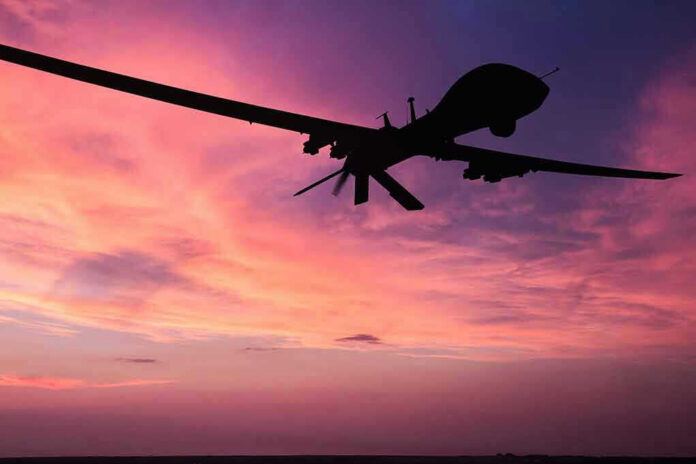
A little-known defense startup just won Pentagon backing for a ship-launched strike drone that could hit targets 1,400 miles away without ever touching a runway.
Story Snapshot
- The Defense Innovation Unit picked Mach Industries to build the Atlas long-range strike drone for the Navy.
- Atlas is designed to launch from destroyers and rough sites, carry a 1,000‑pound bomb, and fly 1,400 nautical miles.
- The aircraft relies on new hybrid-electric “JetFoil” propulsion that has not yet been proven in public flight tests.
- The project shows how taxpayer money is backing high-claim defense startups before their tech is fully verified.
A new kind of strike power for smaller Navy ships
In June 2026, the Defense Innovation Unit, a Pentagon office that scouts new technology, awarded Mach Industries a contract to develop the Atlas drone under the Runway Independent Maritime Expeditionary Strike program. Atlas is described as a large unmanned aircraft built for long-range strikes over water without needing a normal runway. The Navy wants it to fly from ships and rough ground sites that cannot handle fighter jets, giving commanders more reach at lower cost.
The Navy’s request for this program calls for an unmanned aircraft with a one-way range of at least 1,400 nautical miles and the ability to carry a 1,000-pound munition. That payload is meant to match standard bombs now used on F/A-18 Super Hornet and F-35 fighter jets, so Atlas can plug into existing weapons stockpiles. Mach Industries says Atlas will meet these targets while launching from austere locations or ships without large flight decks, including Arleigh Burke-class destroyers.
How Atlas is supposed to fly without runways
Mach Industries and its partner Whisper Aero plan to power Atlas with a hybrid-electric system that uses Whisper’s JetFoil propulsion. Company statements say this design lets Atlas take off from unimproved rotary-wing landing zones while still flying like a fixed-wing aircraft. Mach claims Atlas needs less than half the thrust-to-weight ratio of a true vertical-takeoff aircraft, which should save fuel and extend range, while the JetFoil propulsors are billed as highly efficient and much quieter than typical drone engines.
Program documents say the Navy expects Atlas to operate from smaller surface combatants that normally only support helicopters, such as Arleigh Burke-class destroyers, Littoral Combat Ships, and future frigates. Mach’s own release states that Atlas will be runway independent, able to launch and recover from austere sites in contested logistics environments. Whisper Aero’s chief executive has said JetFoil will allow Atlas to meet RIMES mission needs even from destroyer-class vessels, which speaks directly to the Navy’s demand for more flexible strike options.
Big promises, but no public flight data yet
All of these performance claims still live on paper and in press releases rather than in public test reports. As of June 2026, there is no flight test data available that verifies Atlas’s 1,400-nautical-mile range, payload performance, or launch and recovery from ships. Mach Industries plans to fly a small-scale prototype this year and a full-scale prototype in 2027, but those milestones are goals, not completed achievements, and the government has not yet released evaluation results.
The contract itself is structured in phases, with an initial “tech diligence” tranche and possible follow-on funding if Atlas progresses, which means there is no promise of full production money yet. Mach Industries was founded in 2023 and is widely described as a startup weapons developer, with limited history delivering large defense systems. That youth, plus a reported Series C funding round that pushed the company’s private valuation into the billions, has fueled concern that media and investor hype may run ahead of what the aircraft has actually proven.
What this says about the defense system and public trust
The Atlas deal fits a wider pattern in how the Pentagon now buys unmanned systems. A report from the Center for Strategic and International Studies describes how the United States is leaning on commercial firms and startups to develop drones to a mid-level of readiness before the government deeply commits, moving faster but also accepting more risk. Similar rapid efforts in Navy drone boats and other programs have produced both fast wins and high-profile stumbles when early promises did not survive real-world testing.
PENTAGON PICKS ATLAS DRONE FOR RUNWAY-INDEPENDENT STRIKES FROM SHIPS AND ROUGH SITES
US defense startup Mach Industries won a Defense Innovation Unit contract to develop Atlas, a long-range unmanned aircraft designed to launch from austere sites and ships without conventional… pic.twitter.com/FfF968LYw8— Lusia (@Lusia6756877) July 10, 2026
For many Americans on both the right and the left, this raises familiar worries about an unaccountable defense machine. Conservatives see another example of Washington spending billions on unproven tech while ignoring border control and the cost of living. Liberals see a new autonomous strike platform that could lower the bar for war and deepen the power of what they view as a militarized deep state. Both sides can agree that taxpayers deserve transparent test data, clear oversight, and proof that these drones work as advertised before they reshape U.S. power at sea.
Sources:
zerohedge.com, samsearch.co, breakingdefense.com, aviationtoday.com, prnewswire.com, app.govly.com, fortworthreport.org, defenseone.com
© nationalusnews.com 2026. All rights reserved.