
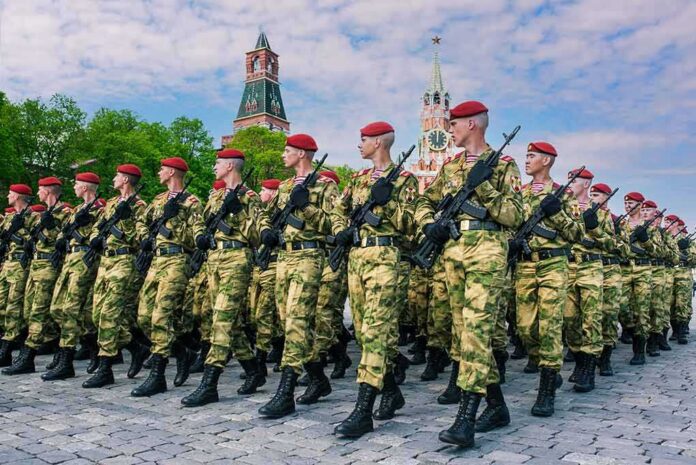
Ukraine says internal Russian documents point to a new post-election draft of hundreds of thousands, while President Vladimir Putin calls the reports “complete nonsense.”
Story Snapshot
- Ukrainian officials say Russia plans a mass call-up after the State Duma vote.
- Reports describe the Kremlin staging political cover to tie any call-up to the new parliament.
- The election date creates a tight window for an announcement if plans exist.
- Putin and allied lawmakers publicly reject the need for mobilization.
What Ukraine Says Is Coming And When
Ukrainian leaders say they obtained Russian documents that outline a new mobilization wave of several hundred thousand men right after the State Duma elections in September. President Volodymyr Zelenskyy repeated ranges between three hundred thousand and five hundred thousand in public comments this summer, citing military intelligence reports. Media in June and August also described a scenario in which newly elected lawmakers would ask Putin to mobilize, linking any move to the post-vote period for political cover.
The timing matters because the Kremlin’s official decree schedules the vote for September 20, 2026, which sets a clear calendar marker. If a call-up is planned, the weeks after the vote would be the likely window, according to these reports. Ukraine’s claims are not backed by a public Russian order. That gap keeps the debate focused on leaks, signals, and denials rather than a signed decree, which lets both sides harden their story for home audiences.
What The Kremlin Says And How It Manages Pressure
Putin dismissed talk of a new mobilization on September 2, calling it “complete nonsense” and an “information attack.” A senior State Duma figure, Andrei Gurulev, also said there were no prerequisites for mobilization and that the army was meeting needs with contract soldiers. At the same time, independent reporting shows the Kremlin can move people at scale for politics, using state pressure to drive turnout and loyalty in elections across regions and workplaces.
Media that monitor Russian elections describe a system of “administrative resources” that can push teachers, doctors, and other state-tied workers to perform political tasks. Outlets reported turnout targets, training for local “mobilizers,” and pressure ahead of primaries and the national vote this year. If the state chooses a draft, that same network could help normalize it or blunt backlash by shaping how the public hears the news, at least in the short run. This capacity, however, is political, not military.
Capacity To Call Up Versus Capacity To Train
Analysts say Russia can call up men but struggles to train, equip, and lead such numbers fast. One military expert estimate claims only about thirty percent of a large intake would get proper training under current facilities. The Institute for the Study of War reported that mobilized recruits already compete with conscripts for limited training capacity, which pushes down quality for both groups. These constraints mattered after the 2022 partial mobilization and remain a real bottleneck today.
On the Russian side: no mass mobilization yet. Putin doesn’t need it. He is indifferent to casualties, still taking ground slowly, and can keep pounding Ukrainian cities until Kyiv fields a cheap counter to missiles. The 35-minute life expectancy figure Ratcliffe cited is…
— Ia Meurmishvili (@iameurmishvili) September 3, 2026
Public reaction is a second brake. Polling and reporting during the 2022 call-up showed fear, anxiety, and protests across many cities, with hundreds detained. The Kremlin later admitted errors in the process. That memory may be why Russian leaders now prefer contract recruitment and denials, keeping formal mobilization as a last resort. Independent experts still see post-election mobilization as possible, but they disagree on scale and timing because the costs are high and the proof is thin.
Why This Matters For Americans Watching Washington
If Russia can surge manpower after the vote, the war could drag longer and stress global energy, food, and defense markets. If it cannot train or support a surge, losses may rise without changing the front lines. Either path burdens ordinary people while elites spin narratives. Americans across the spectrum worry about leaders who hide costs and dodge accountability. This story is a reminder to demand facts, not slogans, before policies shift and bills come due at home.
Sources:
thegatewaypundit.com, militarnyi.com, panopoints.com, kyivpost.com, themoscowtimes.com, meduza.io, carnegieendowment.org, en.kremlin.ru, russian-election-monitor.org, nestcentre.org, epde.org, cepa.org, euromaidanpress.com, newyorker.com, understandingwar.org, cnn.com, theweek.com, iep.ru
© nationalusnews.com 2026. All rights reserved.