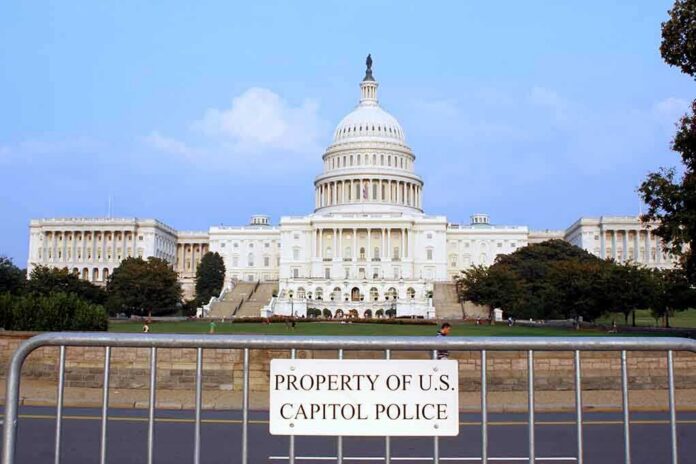
House Republicans just pushed through Trump’s giant tax-and-spending bill that showers cuts on some Americans while leaving millions of others facing fewer benefits and more debt.
Story Snapshot
- The House passed Trump’s “One Big Beautiful Bill Act” by a razor-thin 218–214 vote after intense pressure from party leaders.
- The bill makes Trump’s 2017 tax cuts permanent and adds new breaks, including no federal taxes on tips and overtime pay.
- To pay for these cuts, the bill slashes major safety net programs like Medicaid and food assistance.
- The Congressional Budget Office says the plan will add about $3.3 trillion to the national debt over ten years.
What The House Bill Actually Does
House Republicans passed President Trump’s “One Big Beautiful Bill Act” on a close 218–214 vote, with only two Republicans joining Democrats in opposition. The package locks in the lower tax rates first passed in 2017, so they no longer expire in coming years. It also adds new tax breaks, including ending federal taxes on tips and overtime pay, a key promise Trump made to service and hourly workers. Supporters call this a win for hard work and economic freedom.
Alongside tax cuts, the bill steers hundreds of billions of dollars to border security, deportations, and national defense. It directs money to more agents, detention beds, and technology along the southern border, and boosts military spending on weapons and troop readiness. These moves match long-standing Republican aims to tighten immigration enforcement and show strength overseas. Many conservatives see this as finally putting “America First” in both tax and security policy.
How The Bill Pays For Itself — And Who Loses
To offset the tax cuts and new security spending, the bill makes deep reductions to health and anti-poverty programs, especially Medicaid and food assistance. A Democratic fact sheet warns that stricter work rules and funding cuts could push about 15 million Americans off health coverage. Analysis from liberal policy groups describes this as the largest cut to basic needs programs in modern U.S. history, hitting people who already struggle with medical bills and grocery costs. This is where many Americans, left and right, start to worry.
Nonpartisan budget experts say the math still does not work out. The Congressional Budget Office estimates the bill will add around $3.3 trillion to the national debt over the next decade. Other analysts, using different methods, put the debt increase closer to $5.7 trillion. That means more borrowing, more interest payments, and less room for future leaders to deal with recessions or crises. Older conservatives who remember the party’s talk of balanced budgets see yet another huge red-ink bill. Liberals see proof that promises of “fiscal responsibility” keep getting broken.
Winners, Losers, And A Growing Wealth Gap
Studies based on Congressional Budget Office data show the bill’s benefits tilt toward higher earners. By 2033, households in the lowest income group are expected to see their resources drop by about 4 percent, while those in the top group gain about 2 percent. One widely cited estimate says high-income families could receive tax cuts of around $12,000, while the poorest see costs rise by about $1,600. These numbers feed the claim that the bill moves wealth upward, not toward struggling workers.
The bill does raise the child tax credit and creates new savings accounts for children, sometimes called “Trump accounts.” Families can get a larger credit per child and some kids receive a one-time federal deposit into these accounts. Seniors who rely on fixed incomes also gain from a higher standard deduction if they earn under set limits. These features give supporters real stories they can point to, showing help for families and retirees. But they sit beside cuts to health care and food aid, which opponents say will hit those same families when sickness or job loss strikes.
Why This Fight Feels Familiar — And Why Trust Is So Low
The clash over this bill repeats a pattern seen since the Reagan era: Republican leaders pass big tax cuts framed as unleashing growth and rewarding work, while critics warn about rising deficits and pain for the poor. Earlier laws like the 2017 Tax Cuts and Jobs Act also grew the deficit substantially, even as they were sold as pro-growth and pro-worker. Today’s bill fits that same mold, with patriotic branding on top and a budget score that again points to trillion-dollar debt increases. Many voters see a cycle that never changes.
Media coverage and the vote itself underline how divided Washington is from the public mood. Major outlets call the bill “controversial” and highlight losses in health coverage and the rising debt. All House Democrats opposed it, and a few Republicans broke with Trump in both chambers, even as Vice President JD Vance cast a tie-breaking vote in the Senate. For many on both the right and the left, this looks less like a careful fix for real problems and more like another giant deal pushed through by elites who will not feel the risks they are creating.
Sources:
bbc.com, pbs.org, youtube.com, apnews.com, npr.org, thehill.com, washingtonpost.com, democrats-appropriations.house.gov, democrats-budget.house.gov, bipartisanpolicy.org
© nationalusnews.com 2026. All rights reserved.