President Trump again promised $5,000 to every adult citizen if Republicans keep both chambers in the midterms, even as basic funding and legal steps remain unanswered.
Story Snapshot
- Trump tied $5,000 payments to Republicans winning the House and Senate.
- The White House cited tariffs and growth, but no detailed funding plan exists.
- Critics say the cost tops $1 trillion and needs Congress to act.
- Officials floated reconciliation, yet no bill or timetable is public.
What Trump Promised and the Condition He Set
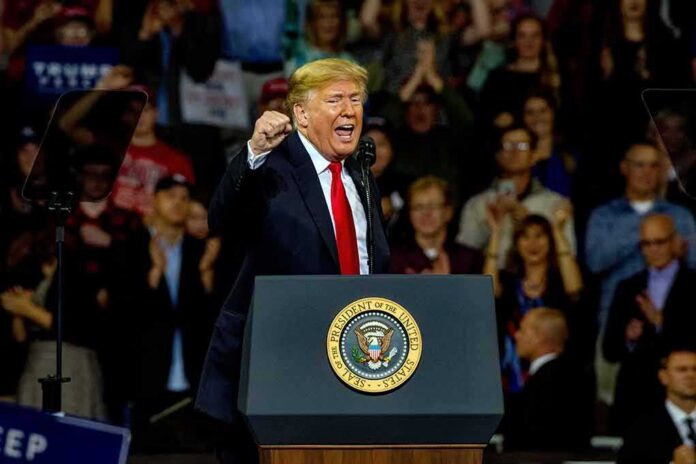
President Trump said he will issue a $5,000 “dividend” to every adult citizen of the United States if Republicans win both the House of Representatives and the Senate in the 2026 midterm elections. He repeated this promise in multiple posts and videos, linking the payment to full Republican control of Congress. The wording centers on “adult citizen,” but it does not define who qualifies or how the government would verify eligibility or prevent duplicate claims.
Trump also described a funding idea. He said the money would come from tariff revenue and strong economic performance, framing the payout as a kind of dividend from government receipts. He did not release a bill draft, a legal memo, or an agency plan that shows how this would work. News coverage stressed that the administration has not offered the public a step-by-step path to move from a campaign-style pledge to an authorized program.
How Much It Could Cost and Why That Matters
Independent estimates place the price tag at above $1 trillion, depending on how many adults qualify. One widely cited figure puts the cost near $1.2 to $1.35 trillion if about 270 million adults received $5,000 each. Reporters compared that sum to recent annual customs duties, which were far lower, raising doubts that tariffs alone could fund the full amount without borrowing or cuts elsewhere. That large gap is the core budget challenge.
Some administration officials suggested a legislative path. They said Congress could use budget reconciliation to approve the payments and that taxpayers would not foot the bill in the usual way. But these claims lack a public financing blueprint, a Congressional Budget Office estimate, or a draft that shows offsets or new revenue. Without those details, lawmakers and analysts cannot judge feasibility or inflation risk from adding over $1 trillion in outlays.
Congressional Hurdles and Legal Questions
Reporters noted that Congress would need to authorize checks on this scale. That means committee work, votes, and a signed law. Coverage highlighted that no enacted statute, executive order with clear authority, or appropriation exists to send $5,000 per adult. Legal experts and economists quoted in news stories said a president cannot spend that much money without Congress, which keeps the pledge in the promise stage, not the policy stage.
Critics also raised election-law and ethics concerns because the promise is tied to a partisan outcome. They argued that linking a federal benefit to whether one party wins both chambers invites legal scrutiny and could be seen as trying to sway voters. Some lawmakers called it illegal or a form of attempted bribery. Other legal voices disagree in separate commentary, but the dispute underscores the risk of court challenges if a bill advances.
Why Both Sides Feel the System Is Failing
People across the political spectrum see this as another sign that Washington promises big and delivers late or not at all. Conservatives worry about more debt, higher prices, and complex programs that help insiders first. Liberals worry about uneven benefits, deeper inequality, and sidelined social needs. Both sides see a pattern: leaders float simple cash offers near elections, while the hard work—funding, rules, and fraud checks—lags or stalls in Congress.
TRUMP REPEATS $5,000 PAYMENT PROMISE AHEAD OF US MIDTERMS
Donald Trump has renewed his promise to give $5,000 to American adults if Republicans win control of both chambers of Congress in the November midterm elections.
He made the pledge during his October 13 rally in Wasilla,… pic.twitter.com/ok6SGmSsjk— D RAY SHOW (@show_ray2026) October 14, 2026
The closest modern example is the COVID-era checks, which only moved after Congress passed laws that set eligibility, delivery, and funding. That history shows direct payments are possible at scale, but only with clear authority, verified lists, and agency capacity. If the White House wants this plan to be real, it will need public bill text, a financing map that matches the trillion-dollar range, and firm votes lined up before the midterms clock runs out.
Sources:
zerohedge.com, trumpstruth.org, cnbc.com, inquirer.com, independent.co.uk
© nationalusnews.com 2026. All rights reserved.