Two attorneys general asked a federal judge to halt President Trump’s 250-foot Memorial Circle arch before ground is broken, warning of traffic gridlock and risks to emergency response that start on day one.
Story Highlights
- Virginia and Washington, D.C. filed a 46-page lawsuit to block construction near Arlington Memorial Bridge.
- The complaint cites traffic, emergency-response, and evacuation risks during a three-year build.
- The suit argues the project lacks required congressional authorization and violates height and review laws.
- The administration says the arch will honor sacrifice and become an iconic landmark.
What Virginia and D.C. Told the Court
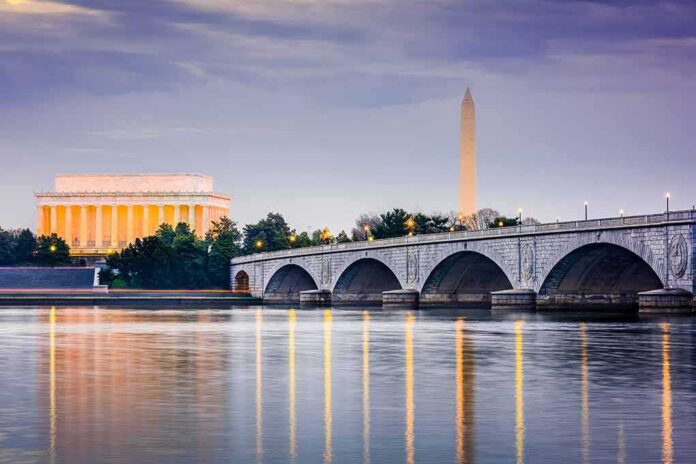
Virginia Attorney General Jay Jones and District of Columbia Attorney General Brian Schwalb filed suit in the United States District Court for the District of Columbia to stop work at Memorial Circle, the traffic hub linking Arlington Memorial Bridge to Virginia. They say the three-year project would choke commuter routes, disrupt cyclists and pedestrians, and slow emergency vehicles that rely on the bridge and circle during daily operations and evacuations. They call the harm immediate and irreparable once digging starts.
The 46-page complaint focuses on transportation and public safety rather than design taste. It identifies lane closures, staging, and detours that could ripple across two jurisdictions. It points to Memorial Circle as a regional choke point and a vital link to hospitals, federal sites, and neighborhoods on both sides of the Potomac River. The filing also says stormwater runoff and construction pollution could reach the river if safeguards are not in place from the start.
The Legal Faults They Allege
The lawsuit says the administration skipped legal steps that Congress set for memorials on federal land. According to reports, the plaintiffs argue the arch lacks explicit congressional authorization, exceeds federal height limits in the capital area, and bypassed environmental and historic-preservation reviews. They frame these as separate violations, so that any one could halt the project while the court reviews the record and the process used to approve the design and the site.
Memorial Circle’s high-profile setting raises the stakes. The planned structure is 250 feet tall at the gateway between the monumental core and Arlington National Cemetery. That scale, the suit suggests, would alter views, traffic patterns, and the experience of a key historic corridor. The attorneys general also note that federal agencies named as defendants control much of the technical data, which could make fast judicial review harder unless the court pauses construction first.
What the Administration Says the Arch Would Do
The White House says the arch will honor veterans and families of the fallen and enhance visits to Arlington National Cemetery. Officials describe it as a landmark with global stature, not just a local structure. In public statements, they argue the project offers symbolic value that matches the nation’s history and sacrifice. They have not, in the available reporting, answered the specific traffic and emergency-response claims with detailed studies.
IT'S OFFICIAL: Facing lawsuits, President Trump designates his DC Triumphal Arch as a MILITARY PROJECT — meaning it just got a lot more difficult for activist judges to stop it. LFG!
REPORTER: DC and Virginia just sued to stop your Triumphal Arch because it violates—
TRUMP:…
— JV (@joveg8) November 1, 2026
Administration comments have also touched on security features. President Trump previously linked the arch to national-security functions, and an Interior Department spokesperson said the current design could accommodate those needs. The Interior Department has pointed to modeling that limits expected shadow impacts on parts of the cemetery to specific, brief windows near sunrise each year. Those points do not directly address Memorial Circle construction logistics raised in the lawsuit.
Why This Fight Resonates Beyond Washington
This clash taps into a broader worry that big federal projects move fast when leaders want a win, while local impacts are treated as an afterthought. Past memorials in Washington often took years of design, planning, and public review. By contrast, this arch advanced unusually quickly, according to prior reporting on similar projects. That gap in process fuels skepticism from both left and right about whether rules apply evenly or only when they are convenient.
For commuters, first responders, and nearby residents, the near-term issue is practical: how the work zone would affect daily life if bulldozers arrive next week. For veterans and families, the long-term question is how a 250-foot structure near sacred ground shapes memory and respect. For courts, the core test is narrow but vital: whether the government followed the laws that protect safety, history, and the environment before it builds something this large in the capital.
What to Watch Next
Watch for an emergency hearing and a request for a temporary restraining order or a preliminary injunction. The plaintiffs must show likely success on at least one legal claim and that harms cannot be fixed later by money. Also watch whether the administration releases traffic plans, emergency-response coordination steps, and environmental safeguards to answer the most concrete worries in the complaint. Early transparency could shape the court’s view and the public debate.
Sources:
thehill.com, nbcnews.com, wdbj7.com, washingtonexaminer.com, independent.co.uk, people.com, kbzk.com, newsweek.com
© nationalusnews.com 2026. All rights reserved.