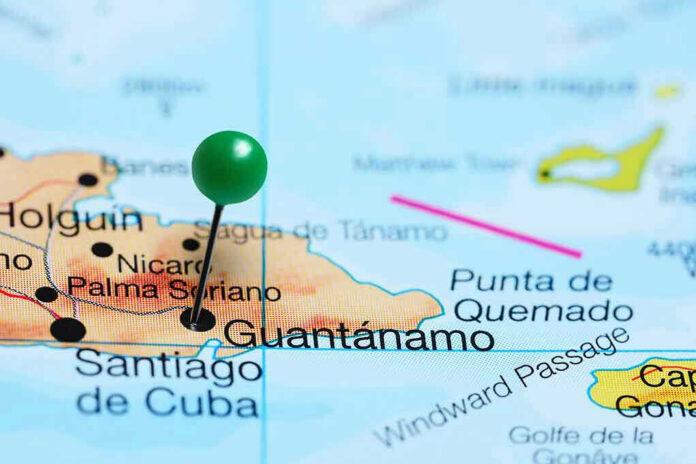
President Trump’s blunt talk about “taking Cuba” is colliding with a real-world energy collapse on the island—and a pressure campaign that could reshape the Caribbean overnight.
Quick Take
- Trump said from the Oval Office he expects to have the “honor of taking Cuba,” framing U.S. leverage as Cuba faces a deep economic and power crisis.
- U.S. actions that tightened Cuba’s access to Venezuelan oil are central to the island’s worsening blackouts and shortages, according to multiple reports.
- Talks between Washington and Havana are underway, with Cuban President Miguel Díaz-Canel publicly acknowledging dialogue while defending sovereignty.
- The administration’s stated approach appears focused on political change at the top rather than a broader, open-ended occupation or total regime purge.
Trump’s “taking Cuba” line signals a high-stakes pivot in U.S. policy
President Donald Trump told reporters on March 16 that he believes he will have the “honor of taking Cuba,” adding that he could “free it” or take other action as the island weakens under an intensifying economic and energy breakdown. The remark follows earlier comments about a possible “friendly takeover,” later tempered with warnings it might not be friendly if conditions deteriorate. The White House has paired that rhetoric with a sanctions-and-energy squeeze aimed at maximizing U.S. leverage.
Trump’s comments also show how the administration is framing Cuba: not simply as a hostile neighbor under a decades-long embargo, but as a collapsing state where Washington believes it holds the decisive cards. For conservatives wary of endless wars, the key question is what “taking” means in practice—diplomacy, targeted pressure for reforms, or something more coercive. Reporting to date points to negotiations and economic leverage first, with potential escalation left deliberately ambiguous.
Energy pressure is the main leverage point—and Cuba is buckling under shortages
Cuba’s vulnerability is rooted in energy. The island has relied heavily on Venezuelan oil in past years, and the current crisis has been linked to U.S. moves that cut off or restrict those flows after power shifted in Venezuela in early 2026. Reports describe severe blackouts, fuel scarcity, and broader shortages that are pushing the country toward a humanitarian and governance breaking point. The administration has also allowed limited resale channels, but coverage indicates it has not met Cuba’s overall needs.
That matters because energy scarcity becomes national instability fast: refrigeration fails, transport slows, and basic commerce grinds down. The conservative takeaway is straightforward: when a foreign government’s survival depends on outside fuel, U.S. policy can quickly become the deciding factor—without deploying troops. Supporters of strong borders and national sovereignty will notice the irony, though: Havana is demanding sovereignty while being structurally dependent on external lifelines, and Washington is using lawful statecraft tools to force choices.
Negotiations are real, but the demands appear political and narrowly targeted
While cable-news chatter focuses on the headline-grabbing phrase, multiple outlets report that talks are ongoing. Trump said on March 15 that the U.S. is “talking to Cuba,” indicating he wanted to finish dealing with Iran first but expected movement “pretty soon,” either through an agreement or whatever steps the U.S. considers necessary. On the Cuban side, President Miguel Díaz-Canel acknowledged discussions publicly and presented dialogue as the preferred path—without accepting U.S. terms.
Reporting also suggests the U.S. objective is not an undefined “nation-building” project, but a targeted political outcome—specifically, leadership change at the top. That distinction is crucial for Americans who watched Washington elites spend decades selling costly interventions with little accountability. Still, there is limited public detail on the negotiating text, deadlines, or enforcement mechanisms, so outside observers cannot yet verify how formalized any transition plan is or what guarantees either side is demanding.
Constitutional clarity at home, credibility abroad: why rhetoric and limits matter
Trump’s language is intentionally maximalist, but U.S. constitutional guardrails do not disappear because a president speaks forcefully. Major military action would still raise legal and congressional questions, and any long-term administration of another country would trigger political backlash at home. For conservatives, that’s not academic: voters have repeatedly rejected globalist “forever commitments” that drain resources while the federal government neglects problems like inflation, debt, and border enforcement.
(VIDEO) Trump Says He'll Have the 'Honor' of 'Taking Cuba' – 'Whether I Free it, Take it, I Think I Can Do Anything I Want with It' https://t.co/vcl77n3Al2 #gatewaypundit via @gatewaypundit
— Dianna Slonaker (@DiannaSlonaker) March 17, 2026
At the same time, the administration’s pressure strategy is being sold as a way to end a hostile dictatorship’s grip close to U.S. shores, especially as Cuba is accused of aligning with major U.S. adversaries. The unresolved issue is how Washington balances moral arguments about freedom with practical limits—avoiding open-ended entanglement while using economic power to push for credible reforms. For now, the hard facts are these: Cuba’s grid is failing, talks are happening, and Trump is publicly keeping every option on the table.
Sources:
https://time.com/article/2026/03/17/cuba-economic-energy-crisis-trump-us-explainer/
https://signalscv.com/2026/03/trump-us-could-reach-deal-with-cuba-pretty-soon/