Colombia moved fast after the 7.4-magnitude quake, with rescue crews, emergency posts, and a national disaster declaration all activated while the damage count kept rising.
Quick Take
- Officials said the quake struck western Colombia and caused deaths, collapses, and injuries across several cities.
- The government declared a national emergency and said it was using that power to move resources quickly.
- Search teams, firefighters, and civil defense crews were sent to the hardest-hit areas right away.
- Hospitals, roads, airports, and homes all faced damage, which widened the crisis beyond the first shock.
Government Response Moves Into High Gear
Colombian authorities declared a national emergency after the quake and framed it as a step to speed aid and coordination. Government disaster guidance says that kind of declaration is used when local systems cannot handle the impact alone and national resources are needed to respond. That matters because the quake was not just a brief shake. It hit multiple departments, damaged key infrastructure, and forced the state to act before the full count was known.
President Abelardo de la Espriella said the national government was keeping all available capacity deployed to protect lives and deliver aid. Reports from the same day described military support, emergency response protocols, and rescue teams moving into the hardest-hit regions. In practical terms, that meant the response began before the situation was fully measured. In a major disaster, speed matters as much as paperwork, because trapped people and blocked roads do not wait.
Rescue Teams Face Collapsed Buildings and Trapped Residents
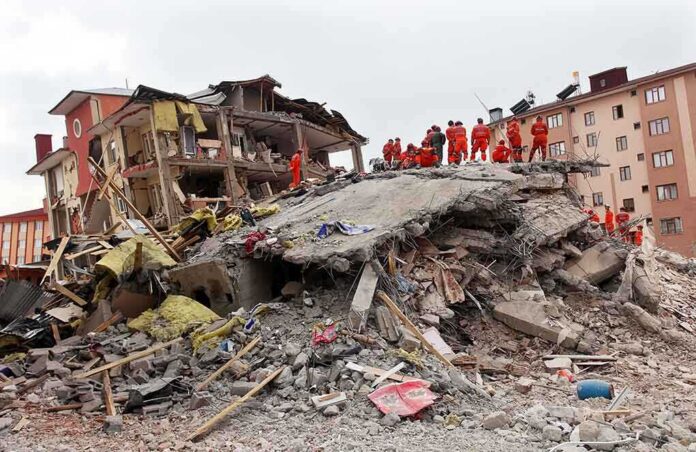
Local reports said the quake caused buildings to collapse in cities including Cali, Pereira, and Manizales, with people still trapped inside. The United Nations said homes and other structures had fallen in several towns and that rescue operations were still underway. Those details explain why officials treated the event as an active emergency, not a finished disaster. Each hour after a collapse can change survival odds for people under rubble.
In Cali, the mayor said at least 20 buildings had collapsed and asked residents to leave damaged structures. Other reporting said search teams were working to pull people from debris while hospitals dealt with damage of their own. That mix of risks creates a hard test for any government. It must find survivors, keep medical care running, and prevent more injuries at the same time. The quake hit all three tasks at once.
Damage Spread Beyond Homes to Roads, Airports, and Public Services
The disruption reached far beyond collapsed walls. One response update said dozens of buildings were damaged, roads were affected, and several airports had infrastructure problems that kept them from normal commercial use. Another report said landslides added to the challenge in western Colombia. When airports, roads, and rescue sites all break down together, aid moves slower and local towns can be cut off. That is one reason disaster declarations carry so much weight.
🚨 Dramatic video recorded by a passenger inside Matecaña International Airport in Pereira, Colombia, captures the intense shaking during the powerful magnitude 7.4 earthquake that struck the country on August 10, 2026. The footage shows movement inside the terminal as debris and… pic.twitter.com/qY3JI9F8T3
— THE INFORMANT (@TheInformantUSA) August 11, 2026
For many Colombians, the quake showed how fast a natural disaster can expose weak points in public systems. The state response appeared organized in the early hours, but the scale of damage still created uncertainty around the final death toll, the number of injured, and the full repair bill. That uncertainty is normal after major earthquakes. It also explains why the first day of response often becomes a test of trust in government, not just a rescue mission.
Sources:
insiderpaper.com, nytimes.com, colombiaone.com, abcnews.com, en.iz.ru, roic.ai, youtube.com, thehindu.com, dialogo-americas.com, ifmnoticias.com
© nationalusnews.com 2026. All rights reserved.