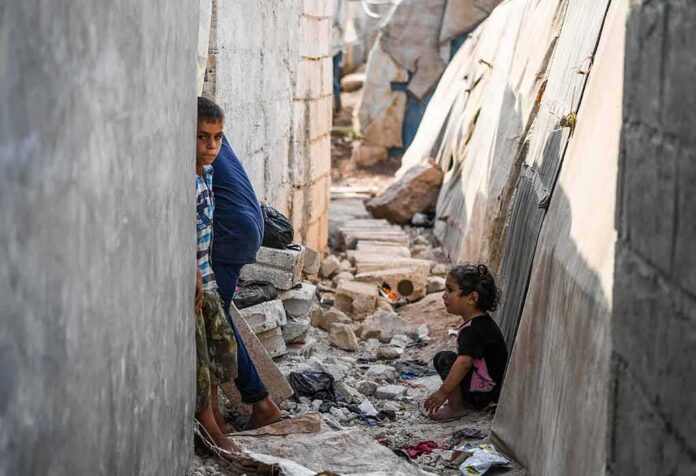
Haiti now faces a man‑made disaster where armed gangs have pushed nearly 1.5 million people from their homes and are pulling children into the violence to keep their power.
Story Snapshot
- Nearly 1.5 million Haitians are displaced inside their own country, most because of gang violence.
- Armed gangs control most of Port‑au‑Prince and are spreading into new regions, cutting off roads and basic services.
- Children are being killed, kidnapped, and recruited by gangs, turning kids into both victims and tools of terror.
- Food, shelter, and safety are collapsing at once, while global leaders offer words and limited action that many Haitians say is far too late.
Gangs Drive Record Displacement Across Haiti
United Nations migration data now show that almost 1.5 million people are displaced within Haiti, about 12 percent of the country’s population. United Nations reports link this surge directly to gang violence, not storms or earthquakes. Armed groups attack neighborhoods, burn homes, and threaten residents, forcing families to grab what they can and flee. Many end up in schools, churches, or crowded camps that were never meant to house people long‑term. Most displaced people have been uprooted more than once as fighting shifts from one area to another.
This crisis has escalated sharply over just a few years. United Nations figures show internal displacement tripled in 2024, from about 315,000 to more than one million people. By mid‑2025 that number climbed to around 1.3 million, then to more than 1.4 million and now near 1.5 million in 2026. Analysts say Haiti now accounts for roughly three‑quarters of all crime‑driven displacement worldwide, making it one of the clearest examples of how violent groups can weaponize fear to rule a country.
Territorial Control and a Collapsing Sense of Security
Since the 2021 assassination of President Jovenel Moïse, armed gangs have taken over most of the capital, Port‑au‑Prince. United Nations reporting and aid groups estimate that gangs control roughly 85 to 90 percent of the city, leaving only small pockets under state authority. These groups also dominate key roads that link the capital to other regions, blocking trade and aid deliveries. Their reach has spread into the Artibonite and Centre departments, areas that used to be safer, where over a thousand people have been killed and hundreds abducted in recent months.
Violence levels look like what many Americans would call a war zone. United Nations human rights data record more than 5,600 people killed in 2024, and nearly 4,900 killings nationwide between October 2024 and June 2025. Killings, rapes, and kidnappings are common tools gangs use to control communities and punish resistance. Human rights experts warn that Haitians face a real risk of mass atrocity crimes, as gangs act with near total impunity and state security forces remain weak, under‑funded, and sometimes corrupted. For ordinary people, there is almost no safe space and little trust in any institution to protect them.
Children Pulled Into the Heart of the Crisis
Children in Haiti are not just bystanders to this violence; they are targets. United Nations child‑protection data show that more than half of displaced Haitians are minors. United Nations and UNICEF reporting describe a 1,000 percent jump in grave violations against children from 2023 to 2024, including killings, maiming, and sexual abuse. Many kids have lost access to school as classrooms become shelters, making them even more vulnerable to gangs who offer food, protection, or money in exchange for joining.
Humanitarian and rights groups say gangs are actively recruiting children, sometimes forcing them at gunpoint, sometimes pulling them in through families who depend on gang income. Children are used as lookouts, couriers, and fighters, and some are pushed into sexual slavery as a way to terrorize entire neighborhoods. These acts deepen the trauma and help gangs build a new generation of members who know only violence and rule by fear. Once inside a gang, escape is rare, and there are few functioning courts or social services to help kids get out and rebuild their lives.
Humanitarian Breakdown and Global Responsibility
Haiti’s humanitarian system is buckling under the pressure. United Nations figures show about 5.7 million people are going hungry, and many children leave school to help families find food. Over one million displaced people rely on host families or crowded sites where water, toilets, and health care are scarce. Aid workers warn that disease, malnutrition, and untreated injuries could kill many more people than bullets if funding and access do not improve quickly.
This disaster also feeds a wider anger that many Americans feel about global elites and failing governments. Haitians see international speeches and limited missions while gangs grow stronger and basic safety disappears. United Nations experts call for “long‑term engagement,” but humanitarian plans for Haiti have often been underfunded and slow. For citizens watching from the United States, Haiti can look like another example where institutions talk about human rights yet cannot stop a small group of violent men from wrecking an entire nation.
Why This Matters Beyond Haiti
Haiti’s crisis raises hard questions that cut across left‑right politics. Armed gangs thrive where governments are weak, police are corrupt or under‑resourced, and outside powers focus more on speeches than on results. The same worries many Americans have about a distant “deep state” or unaccountable elites are now playing out in Haiti in extreme form: leaders far from the slums set policy, while families on the ground pay in blood and hunger.
For conservatives, Haiti’s breakdown supports fears that open borders, global crime networks, and soft responses to lawlessness can spill over into the wider region. For liberals, it reflects how inequality, failed development, and neglect of human rights allow violent groups to fill the gap where the state disappears. In both cases, Haiti is a warning: when institutions fail to protect ordinary people, someone else will rule by force. The question is whether global and national leaders will act before even more children are lost to this man‑made disaster.
Sources:
gatewayhispanic.com, news.un.org, rescue.org, apnews.com, globalinitiative.net, crisisgroup.org, ohchr.org, dataviz.unhcr.org, acaps.org, bbc.com, france24.com, globalr2p.org
© nationalusnews.com 2026. All rights reserved.