
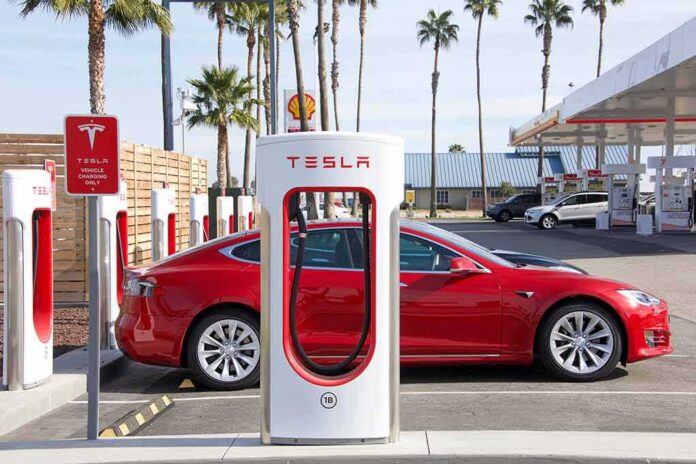
Tesla quietly opened invite-only sales of its steering‑wheel‑free Cybercab at $29,990 with a required $299 monthly autonomy fee, turning car ownership into a subscription product that only works inside company-approved zones.
Story Snapshot
- Tesla invited select customers to order the Cybercab for personal use.
- The price is $29,990 before taxes, plus a $299 monthly autonomy subscription.
- Orders require a $1,000 non-refundable deposit and limit use to supported areas.
- Initial availability is narrow, with December 2026 deliveries listed as estimates.
Tesla Opens Personal Cybercab Orders With Required Subscription
On November 13, Tesla moved the Cybercab from concept to a limited sale by inviting select customers to place personal orders. The order page lists an estimated purchase price of $29,990 before taxes, undercutting Tesla’s least expensive Model 3 by several thousand dollars. Buyers must also agree to a $299-per-month “Autonomy Subscription” to operate the vehicle, with the first month included and ongoing charges after that unless canceled. Tesla labels this an early-access, limited release.
The offer includes a $1,000 non-refundable deposit and emphasizes that availability is restricted. Buyers are limited to one vehicle unless Tesla approves more. The terms say operation is allowed only inside supported service areas, commonly described as robotaxi zones or geofences. The ordering flow presents December 2026 as an estimated delivery date, not a guarantee, and it does not disclose final destination, insurance, or maintenance costs beyond the subscription note.
How The Price And Monthly Fee Fit Tesla’s New Model
The $29,990 headline price signals a low entry point compared with other Teslas, but the required $299 monthly payment changes the total cost over time. Tesla states that “subscription and regular vehicle maintenance” are required to operate, making software and service central to ownership rather than optional add-ons. Reporters describe the fee as tied to autonomy, though the exact bundle of software, connectivity, and services covered is not fully detailed in public materials.
This move fits a larger auto shift from one-time sales to recurring software revenue. Tesla already markets Full Self-Driving subscriptions across its lineup, and independent coverage has highlighted rapid growth in paid subscribers and analyst estimates for recurring revenue. A recent investor discussion cited about 1.74 million active Full Self-Driving subscriptions and roughly $1 billion in annual recurring revenue, with Tesla’s chief financial officer calling that estimate “generally right”.
Limits On Availability And Where The Car Can Operate
Tesla’s launch remains narrow. The invitations target select buyers, and the company frames the Cybercab as early access with limited availability. Operation is restricted to supported service areas, which ties real-world usefulness to where Tesla has built and maintains robotaxi geofences. That means a buyer’s value depends on local coverage and on Tesla’s ability to expand those zones over time. Initial reporting focuses on invitations, order terms, and estimated deliveries, not completed handovers.
Regulatory context matters for a vehicle without a steering wheel and pedals. Federal guidance allows limited exemptions from safety standards for innovative designs when safety is deemed equivalent, with caps such as 2,500 vehicles per year over two years. Prior self-driving programs have navigated similar pathways, and federal discussions continue on how to treat controls like brake pedals in autonomous vehicles while keeping strict stopping requirements. This backdrop helps explain Tesla’s staged, area-limited rollout.
What This Means For Drivers, Cities, And The Market
For drivers, the headline price looks affordable, but the mandatory subscription makes long-term cost hinge on monthly payments. For cities, a geofenced system could add point-to-point rides with tight control but may raise questions on access and street rules. For the market, Tesla is testing a model where software and service fees are central to how a car runs. The company can update terms, pricing, and supported areas, which concentrates power over the product experience.
Elon says Tesla will gradually expand sales of the $29,990 Cybercab to the general public across the U.S. for personal use, with the $299/month autonomy subscription cost eventually dropping to around $115/month. https://t.co/StrTreLptY pic.twitter.com/L2XjvZ6rAj
— Sawyer Merritt (@SawyerMerritt) November 14, 2026
The biggest near-term tests are simple and practical: where buyers can use the car, when deliveries occur, and how the subscription delivers value. Reporting documents the invitation-only sale, price, deposit, and the $299 fee required to operate the vehicle. It also shows a limited, early-access posture with geofenced use and an estimated December delivery window. Those concrete steps mark a real, if narrow, commercial turn toward cars that run on code and a monthly bill.
Sources:
youtube.com, gettesla.com, evpulse.com, teslant.com, editusa.com, nhtsa.gov, insideevs.com, teslanorth.com
© nationalusnews.com 2026. All rights reserved.