
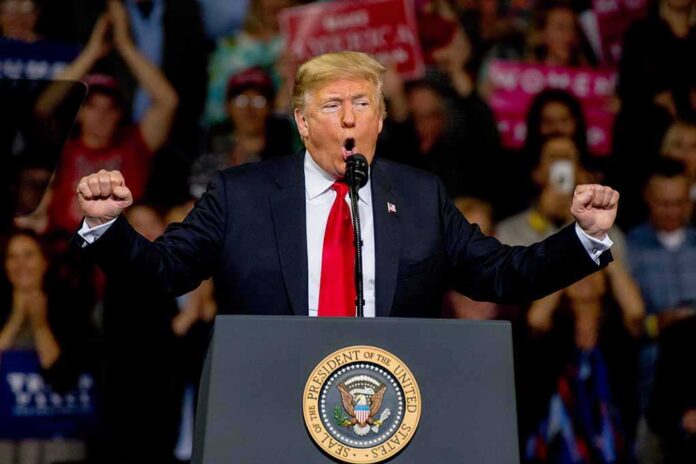
President Trump turned a question about a contested Ohio campaign ad into a personal attack on an ABC News reporter, shifting focus from the ad’s facts to a fight with the press.
Story Highlights
- Vivek Ramaswamy’s campaign confirmed it produced and funded the ad featuring Amy Acton’s estranged mother.
- The ad touches on a painful family history and drew bipartisan criticism, including from Ohio’s Republican governor.
- Trump said he knew “nothing” about the ad’s backstory while defending its use and belittling an ABC reporter.
- The dispute shows how harsh personal ads and attacks on journalists can drown out policy debate.
What Sparked The Confrontation
The clash followed questions about a one-minute ad from Vivek Ramaswamy’s Ohio governor campaign. The campaign acknowledged producing the spot and said it planned a four million dollar media push to air it statewide. The ad features Amy Acton’s estranged mother, Donna Arthur, calling Acton a liar and urging voters to oppose her. Reporters pressed Trump on the ad’s content and on his view of the tactic. Trump responded by belittling the ABC reporter while also defending the ad’s use.
Reporters asked because the ad reaches into a disputed and sensitive family history. News reports say Arthur had not seen Acton in decades, and that Acton’s stepfather was indicted for raping her when she was 12, while her mother later lost custody. Acton and her brother have publicly discussed this history, and the claims are central to criticism that the ad crosses a moral line. The ad’s supporters argue it raises character questions that voters should hear.
How Trump Answered — And Didn’t
Trump said he knew “nothing” about the ad’s backstory but still argued the mother’s criticism should be taken seriously. He framed the dispute as a mother speaking about her daughter and said it had nothing to do with a stepfather, downplaying the abuse claims at the center of the backlash. He went further and said the ad was “powerful” and that he would use a similar spot himself, encouraging Ramaswamy to keep it up.
During the exchange, Trump shifted from the ad to the media. He attacked ABC and insulted the reporter’s appearance, which turned a question of campaign standards into a spectacle over press conduct. That move plays into a familiar pattern. Leaders often try to redirect hard questions by discrediting the person asking them. The result can be less light on the facts and more heat about personalities. Voters lose when coverage focuses on insults instead of evidence.
What We Know About The Ad — And What We Don’t
Ramaswamy’s team clearly owns the ad. The campaign said it produced the spot, featured Arthur on camera, and bought large statewide airtime. The content accuses Acton of lying about her past, with Arthur saying her daughter has a “serious problem”. The Associated Press and others have reported the estrangement, the stepfather’s indictment, and the custody loss, which helps explain why the ad drew swift and loud criticism. Republican Governor Mike DeWine publicly urged Ramaswamy to pull the ad, signaling bipartisan concern.
Some questions remain. The public record does not show that Trump approved, coordinated, or even knew about the ad before it aired. The available reporting also does not settle every claim inside the ad or provide full case files on the family history. ABC News earlier noted it could not verify all details when the video first spread online. These limits matter. Voters deserve firm facts when a campaign asks them to judge character based on personal pain.
Why This Matters Beyond One Race
Ohio’s governor race has turned sharply personal. Analysts note that such attacks often fire up a base but can leave swing voters cold. This ad goes further by centering on alleged childhood abuse, which raises the stakes and the risk of harm if the claims are mishandled. When politics turns to family trauma, the line between accountability and exploitation gets thin. The debate should focus on verifiable facts and on issues that will shape how people live and work.
Trump on an ABC News reporter questioning the Ramaswamy ad: "I had one woman from ABC fake news. I recognized her immediately, not a particularly attractive person inside or out. She's a nasty person. I've had a lot of problems with her." 📺🎤👀🔥 pic.twitter.com/DV2JJpORpM
— World Matters (@world_matters1) October 23, 2026
The exchange also shows a broader trend: public officials fighting the press instead of the premise of a question. Many Americans on the left and right already feel the system serves the powerful first. When leaders mock reporters, and when news outlets chase the viral clip, voters see more theater than truth. That cycle erodes trust in both government and media. Breaking it will require campaigns to back claims with records and leaders to answer tough questions directly.
Sources:
mediaite.com, cnn.com, pbs.org, apnews.com, us.cnn.com, politifact.com
© nationalusnews.com 2026. All rights reserved.