
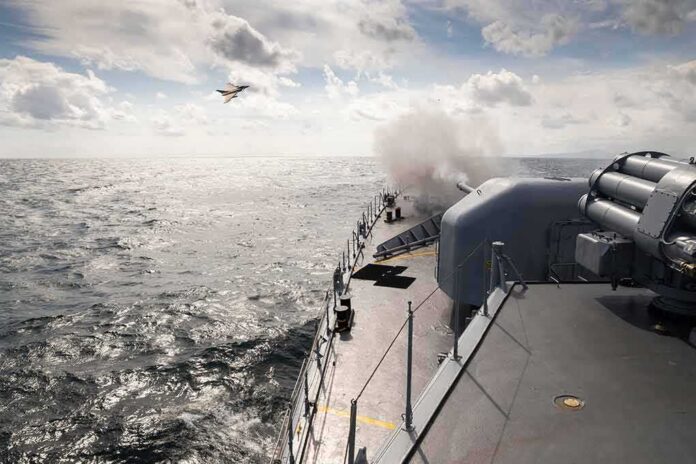
American warships and Iranian forces have now traded direct fire in the Strait of Hormuz, and the U.S. Navy answered by sinking or disabling three Iranian oil tankers in one of the most dangerous escalations in the region in years.
Story Snapshot
- U.S. Central Command says its forces disabled or destroyed three Iranian oil tankers after Iran fired ballistic missiles at two Navy ships, which were not hit.
- CENTCOM says it struck more than 80 Iranian targets in follow-up rounds, including air defenses, radar sites, and small boats.
- Iran’s Foreign Ministry calls the U.S. strikes a “gross violation” of an April ceasefire and says it will use “all capacities” to hit back.
- The clashes have unfolded in repeated rounds since May 2026, with both sides claiming the other struck first each time.
Navy Ships Dodge Missiles, Tankers Take the Hit
U.S. Central Command said Iran’s Islamic Revolutionary Guard Corps fired ballistic missiles at two Navy ships in the Strait of Hormuz. Both ships avoided the missiles and were not damaged. Hours later, American forces struck and disabled three Iranian oil tankers, a response the command called “self-defense strikes” meant to protect U.S. troops in the waterway.
Central Command has repeated this same language in statement after statement this year. In one release, the command said it does not “seek escalation” but “remains positioned and ready to protect American forces”. That message has stayed consistent even as the strikes have grown bigger and more frequent, moving from single tankers to strikes on dozens of targets at once.
Strikes Have Widened Far Beyond the Original Ships
The May clash was not a one-time event. By July, Central Command said it had completed a new round of strikes hitting more than 80 targets in Iran, including air defense systems, coastal radar, and roughly 60 small boats. The command said the goal was to “degrade Iran’s ability to continue attacking international commerce” moving through the Strait.
Days later, Central Command said it finished a third round of strikes in one week, this time “holding Iranian forces accountable” for hitting another commercial ship in the Strait. U.S. forces also used 5,000-pound bunker-buster bombs on hardened Iranian missile sites near the waterway, according to the command. Each round has followed the same pattern: an Iranian attack on shipping, then a bigger American response.
Iran Says Its Own Ship Was Hit First
Iran tells a different story about who started the latest round. Iran’s Foreign Ministry said a U.S. strike hit an Iranian oil tanker near the Strait of Hormuz with an air-launched missile, damaging its engine room without sinking it, and called the U.S. a “terrorist army”. The ministry said the strikes broke a ceasefire reached in April and violated international law banning the use of force.
Iran’s Revolutionary Guard said its own attacks were retaliation for that earlier U.S. strike on the tanker, plus what it called an attack on a communications tower on Qeshm Island. Iran’s state broadcaster also said U.S. strikes hit an Iranian tanker near Jask and another vessel near Fujairah, and that Iran fired back at U.S. military ships east of the Strait. Neither side’s claims have been independently confirmed.
A Chokepoint With a Long History of Disputed Attacks
The Strait of Hormuz has seen this cycle before. Roughly a fifth of the world’s oil passes through the narrow waterway, and past incidents there, including tanker mine attacks in 2019, have often ended in competing claims about who attacked first and whether the response was fair. Legal scholars note these disputes usually hinge on whether an attack counts as serious enough to justify a military strike back, a question that can take years to settle in court.
Trump Downplays the Fighting as Iran Warns of More Attacks
President Trump has described the ongoing exchanges as a “conflict,” not a full war, even as Central Command pushes back on Iranian claims that it controls passage through the Strait, calling that assertion false. Iran’s Foreign Ministry has said it will use “all capacities” to counter what it calls American aggression, suggesting more rounds of strikes and counterstrikes are likely in the Strait’s crowded shipping lanes.
The US military is retaliating for Iranian missile attacks on US Navy warships.
American Navy ships have carried out strikes on three Iranian oil tankers.. with two that the U-S says are permanently disabled, and a third that has been destroyed.
The U-S military says an aircraft… pic.twitter.com/iQL6lmQP0p— Worldwide News Network (@WorldwideNNX) September 6, 2026
For Americans watching from home, the exchanges raise a familiar worry regardless of party. Every new round of strikes adds risk of a wider war and higher gas prices, decisions made far from public view and with little clear endpoint. Both sides say they are acting in self-defense, but neither has offered independent proof, leaving the public to weigh dueling military statements from two governments with every reason to shade the truth in their own favor.
Sources:
facebook.com, reuters.com, defence-blog.com, aljazeera.com, foxnews.com, centcom.mil
© nationalusnews.com 2026. All rights reserved.