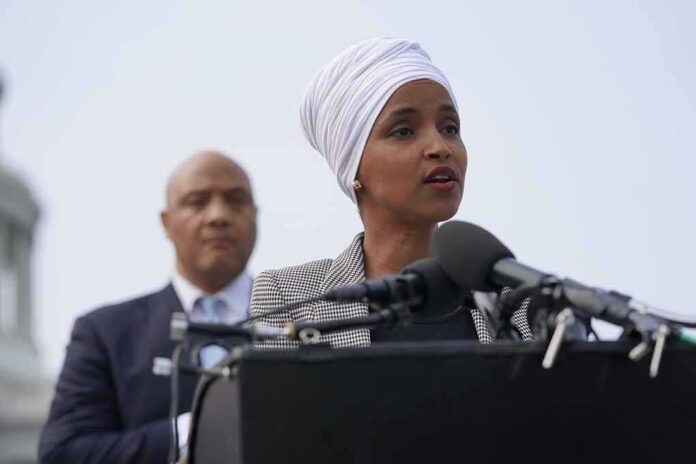
Representative Ilhan Omar introduced a bill to redirect about $140 billion from federal immigration enforcement to local recovery and aid programs.
Story Snapshot
- Omar’s Make ICE Pay Act would move roughly $140 billion from Immigration and Customs Enforcement and Customs and Border Protection to local grants.
- The bill ties to “Operation Metro Surge” in Minnesota and frames funds as reimbursement and recovery.
- Grants would support state and local governments, nonprofits, schools, and small businesses hit by enforcement actions.
- The push challenges recent multi-year enforcement funding enacted by Congress.
What The Bill Would Do With Existing Enforcement Funds
Representative Ilhan Omar said the Make ICE Pay Act would block and redirect about $140 billion that Congress set aside for Immigration and Customs Enforcement and Customs and Border Protection. Her office describes the money shifting to a grant program focused on communities facing costs from large enforcement operations. Reporting states that funds would flow to local governments, nonprofits, schools, and small businesses to cover damage and recovery needs tied to immigration crackdowns. A related release highlights a reimbursement focus.
Omar pairs the grant idea with a claim that local budgets take a hit when enforcement surges. The text, as described in public summaries, places the Department of Housing and Urban Development as the likely grant manager, channeling awards to eligible groups harmed by the operations. This model mirrors other federal disaster or impact grants. It would mark a shift in how Washington treats the fallout from immigration actions, by paying local costs rather than expanding detention or removal capacity.
The Trigger: “Operation Metro Surge” And Minnesota Impacts
Omar linked the bill to the conclusion of “Operation Metro Surge” in Minnesota, a recent enforcement action that she says drove local harm and costs. Her press office used the operation as the immediate reason for filing the bill. A companion announcement with Representative Angie Craig described reimbursing states for costs and damages attributed to Immigration and Customs Enforcement activity, grounding the proposal in specific claimed local impacts rather than general policy goals.
Supporters frame the plan as payback for what they call disruptions when large teams move into neighborhoods or workplaces. They say cities, schools, and small businesses absorb indirect costs that federal budgets do not cover, from lost work hours to property damage and emergency services. The measure would put federal dollars toward those bills. It would not change immigration law or enforcement authority directly, but it would divert money that agencies expect to use for operations.
Why The Funding Fight Matters In Today’s Washington
Congress recently locked in major multi-year money for border and interior enforcement through broader spending laws that stretch into future fiscal years. Analysts estimate those laws added well over one hundred billion dollars across immigration and border activities, giving agencies planning room for detention beds, transport, and technology. Omar’s bill would pull a large share of that pool back to local ledgers, a clear clash with the current enforcement-first budget posture.
For years, the Department of Homeland Security has shifted funds within accounts after Congress passes a budget, under rules that require notice to appropriators. The Government Accountability Office reported Department of Homeland Security notices moving about $1.8 billion over a decade to support Immigration and Customs Enforcement needs. Critics say those shifts weaken oversight. The new bill pushes the opposite way: cut agency cash and send it outside Washington to those who say they bear the costs.
How It Could Affect Communities, Agencies, And The Next Budget Cycle
If enacted as described, the grant funding could help local governments repair damage, backfill lost income for small businesses, and expand services after raids or sweeps. Nonprofits and schools could seek help for counseling, legal aid, and student support. That could ease the shock when enforcement surges hit a region. The scale—about $140 billion—suggests multi-year impact awards and a formal application system at a cabinet department.
🚨 ILHAN OMAR INTRODUCES BILL TO REDIRECT NEARLY $140 BILLION FROM ICE AND CBP
Rep. Ilhan Omar is proposing a major change to how nearly $140 billion in federal immigration-enforcement money would be spent.
Omar and Rep. Angie Craig introduced the Make ICE Pay Act on September… pic.twitter.com/12Wsna0cA3
— MKKM (@michekyakeymii) September 19, 2026
For federal agencies, losing that sum would likely force a reset of detention targets, transport contracts, and staffing plans built on the recent appropriations. Supporters of strict enforcement would argue the cut harms core missions. Backers of the bill would argue the money finally matches real local costs. The path forward runs through House and Senate committees. With Republicans controlling Congress and President Trump in the White House, the bill faces steep odds, but it spotlights a growing fight over who pays for federal actions.
Sources:
twitchy.com, omar.house.gov, congress.gov, gao.gov
© nationalusnews.com 2026. All rights reserved.